The Universe’s Most Gargantuan Black Hole: The Incredible
Story of TON 618 black hole– Size, Mystery, and Cosmic Limits
Greetings! Have you ever wondered if there is an object in the universe compared to which our
entire solar system would look like a tiny speck? Or a black hole with gravitational power so
immense it could swallow billions of suns? Today, we are talking about Ultra massive Black
Holes, specifically TON 618 black hole—one of the most massive black holes known to mankind.
This article will spark your curiosity about black holes and introduce you to the staggering scale
of the cosmos. Let’s dive in!
What are Black Holes and How are They Formed?
Black holes are the most mysterious objects in the universe. They are so dense and their gravity is
so powerful that even light cannot escape them. The Event Horizon is the “point of no return”
boundary surrounding them.
Black holes are primarily categorized into three types:
Stellar Black Holes: Formed from the supernova explosions of massive stars. Their mass
typically ranges from 3 to 100 solar masses. For example, the black hole in M33 X-7 has a
mass of about 15.6 solar masses and exists in a binary system with a star.
Supermassive Black Holes: Found at the centers of galaxies. In our Milky Way,
Sagittarius A* has a mass of approximately 4.3 million solar masses. Its event horizon
diameter is relatively small—roughly the size of Mercury’s orbit.
Ultra massive Black Holes: These are the largest of all. Their mass can reach tens of
billions of solar masses.
Interestingly, there is (theoretically) no upper limit to how large a black hole can grow. They grow
over time by consuming gas, stars, and merging with other black holes. However, the age of the
universe (about 13.8 billion years) acts as a practical limit to their growth.
How Small is Our Sagittarius A?
As mentioned, the black hole at the center of the Milky Way is 500 times smaller than our solar system—this is mathematically accurate. The diameter of the event horizon of Sagittarius A is
about 44 million kilometers (similar to Mercury’s orbit). If placed at the center of our solar
system, it would be much smaller than Pluto’s orbit.
A thought experiment: If we compressed the Sun into a black hole the size of a 25-paise coin
(approx. 2cm), its gravitational pull would still be enough to keep the Earth orbiting it like the
Moon!
TON 618 black hole: The Largest Known Black Hole in the Universe
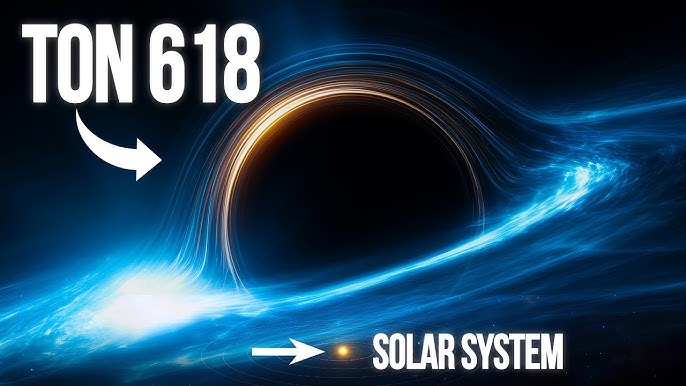
TON 618 black hole is a Quasar located about 10.8 billion light-years away from Earth. The TON 618 black hole at its
center is truly ultra massive.
Mass: Estimated between 40.7 to 66 billion solar masses. (While some studies suggest 66
billion, 2019 estimates suggest 40.7 billion). This is more than the total mass of all the stars
in the Milky Way galaxy!
Size of the Event Horizon: According to the Schwarzschild Radius, its diameter is
hundreds of billions of kilometers—roughly 800 to 1,300 AU (Astronomical Units).
Comparison: Our solar system (from the Sun to Neptune) is about 60 AU in diameter.
TON 618’s event horizon is 30–40 times larger than our solar system. If placed in
our system, the entire solar system would fit inside it many times over.
Mind-Blowing Fact: Even at the speed of light, it would take weeks or days just to cross
the event horizon. Reaching the singularity would take even longer!
Brightness: TON 618 black hole shines with the brightness of 140 trillion suns—more brilliant than
thousands of galaxies combined. Because it is so far away, we are seeing it as it was 10
billion years ago. It is likely even larger today!
TON 618 black hole
Black Hole Growth: Is There No Limit?
Limits for Planets: If they gain too much mass, they become stars.
Limits for Stars: Due to the Eddington Limit, stars generally cannot grow beyond 250–
300 solar masses without blowing themselves apart.
Black Holes: They have no physical limit. they can grow infinitely by merging or
consuming matter. Time is their only constraint.
Primordial Black Holes: According to Stephen Hawking’s theory, tiny black holes might
have formed from pure energy in the first moments of the Big Bang. Some scientists
believe Dark Matter might be composed of these microscopic black holes. However, this
remains a hypothesis and has not yet been confirmed by the James Webb or Hubble
telescopes.
Interesting Comparisons
Smallest Known Stellar Black Hole: Mass of about 3.8–5 solar masses with a diameter of
only 15–20 kilometers (you could fit several inside a city like New Delhi).
M33 X-7: A stellar black hole consuming a 70-solar-mass star, though the black hole itself
is only ~16 solar masses.
OJ 287: A binary system with two supermassive black holes; the primary one is ~18 billion
solar masses.
Singularity vs. Event Horizon
The “true” size of a black hole is measured by its Event Horizon, not the Singularity (which is a
point of infinite density). At the singularity, our current laws of physics break down.
Conclusion: What Does the Universe Teach Us?
Objects like TON 618 black hole remind us of the vastness of the universe and our tiny place within it. Black holes are not just symbols of destruction; they play a vital role in shaping and evolving galaxies.
Is Dark Matter actually made of Primordial Black Holes? Is there a black hole out there even
larger than TON 618 black hole? Science is still searching for these answers.
If you enjoyed this article, let us know in the comments—what do you think about TON 618 black hole
? Do you want to know more details? Like and share, and keep your cosmic curiosity
alive!