Where is the Center of the Universe? Is the
Origin of the Big Bang Right Above Your
Head?
Hello friends! Imagine this vast universe—trillions of galaxies, countless stars, black holes—and
where exactly is its center of the universe? If someone like Gaurav asks, “It’s right above your head!”, you might
find it hard to believe. But science says that the question “Where is the center of the universe?”
isn’t that simple. In today’s blog, we will uncover where the center of the universe lies, where the Big
Bang happened, the Heliocentric vs. Geocentric theories, and how CMB Radiation helps us
understand it all.
If you are curious about the Big Bang Theory or Cosmic Microwave Background, this article is
for you! Let’s begin our journey into this space mystery.
A Quest Since Ancient Times: Where is the center of the universe?
The curiosity to find the center of the universe has existed since the 3rd century BC. Ancient
Greek philosophers were the first to contemplate this. There were two main theories:
- Aristarchus’s Heliocentric Model: The Sun is the center of the universe of everything. Earth and other planets revolve around the Sun. This was revolutionary!
- Aristotle’s Geocentric Model: Earth is the center. The Moon, stars, and planets revolve around the Earth like crystal spheres. This was simple and suited the status quo.
People accepted Aristotle’s theory because it aligned with religion. The concepts of Heaven and
Hell fit perfectly—Earth in the center, stars at the boundary, and Heaven/Hell beyond that. But
supporting Heliocentrism? If every star has its own solar system, where would you place Heaven?
It was considered Blasphemy!
During an era dominated by religious power, Nicolaus Copernicus, Giordano Bruno, and
Galileo pushed Heliocentrism forward. The result? Bruno was burnt at the stake, and Galileo was
placed under house arrest. However, the invention of the telescope (by Galileo and Newton)
brought the truth to light. The universe isn’t flat, and every object has its own center!
Structure of the Universe: A Center for Everything
We learn that galaxies revolve around supermassive black holes, solar systems revolve around
stars, and moons revolve around planets. Everything spins and revolves. But where is the center
of the universe itself?
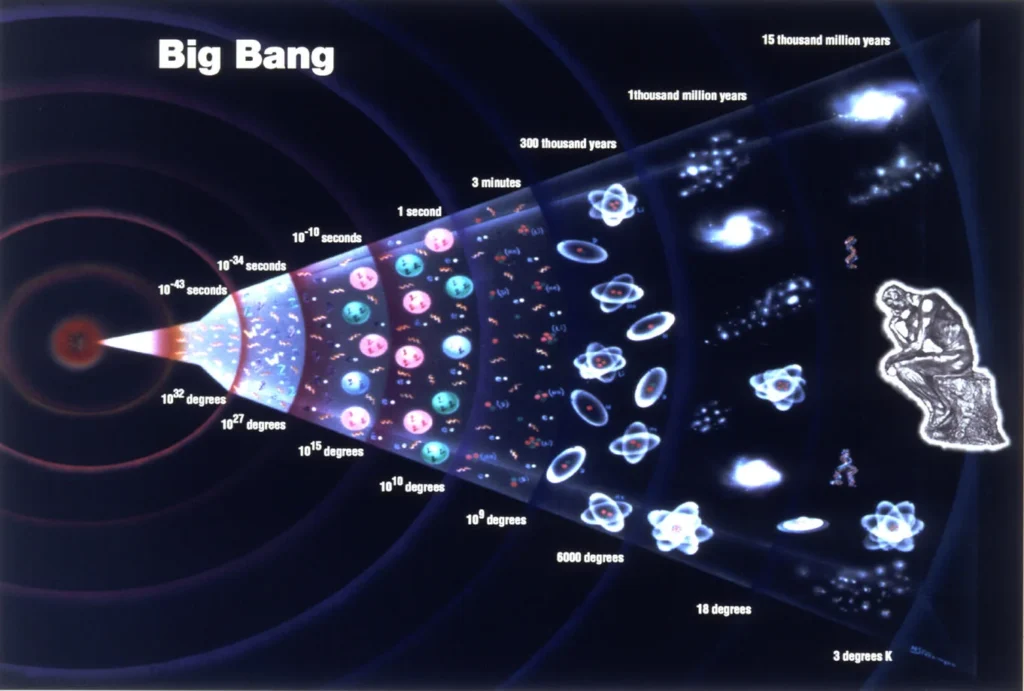
Scientists studied Cosmic Microwave Background Radiation (CMBR). This is the “echo” of
the Big Bang. Since galaxies are moving away from each other, if you rewind the clock, you
should find the Big Bang’s location—much like rewinding footage of bomb shrapnel to find the
origin of the blast.
The Problem? Wherever you point a CMBR device, it shows the Big Bang right there—directly
above your head! Why? Because the Big Bang was not an explosion in space, but an expansion
of space itself.
The Balloon Analogy: Why Do We Feel Like the center of the universe?
Imagine a balloon with dots (galaxies) drawn on it. Fill it with air—the dots move away from
each other. Looking from any single dot, it seems like everyone else is moving away—making
you feel like the center! The universe is just like this. There is either no center, or every place
is the center.
Observable Universe vs. Real Universe: The Real Hurdle
Today’s telescopes can see up to 14 billion light-years away. However, the edge of the
Observable Universe is actually 46 billion light-years away. Why?
- Light took 14 billion years to reach us.
- The expansion of the universe is incredibly fast—25.59 million light-years per second.
- By the time the light reaches us, that galaxy is now 46 billion light-years away!
This means the Observable Universe is just a tiny portion. The real universe could be infinite.
While the James Webb Space Telescope (JWST) has provided new discoveries, there is still a
limit.
The Deception of the Doppler Effect and Redshift
CMBR images show Redshift (moving away) and Blueshift (moving closer). We are moving
toward the Local Group at a high speed (370 km/s), which creates false signals. Since
Expansion Speed > Light Speed, redshift doesn’t always accurately represent distance.
The Best Way to Find the Real Center: Center of Gravity
Observation can be deceptive. Use the Center of Gravity (CoG) instead! For example:
- A Bicycle’s Center: The shape is irregular—measurements might lead to different points. But CoG finds it perfectly by looking at mass concentration.
- Solar System: The Sun (99.8% of the mass).
- Galaxy: The Supermassive Black Hole.
For the universe? The CoG would be where the maximum concentration of galaxy clusters and
superclusters lies. But since the Observable Universe is only like the “front tire of the
bicycle,” we cannot find the CoG without a full panorama. The Virgo Supercluster (our region)
feels like a local center, but the true center could be much further away.
New Science Updates: What Have We Learned by 2026?
By 2026, the JWST has shown us ancient galaxies formed very shortly after the Big Bang. Dark
Energy (68% of the universe) is accelerating the expansion. Multiverse Theory suggests our
universe is just one bubble among many.
- Pros: CMBR showed a homogeneous universe
- Cons: Dipole anisotropy creates a “false center.”
In the future, the SKA Telescope or AI simulations will help us further.
Where is the center of the universe? What are your thoughts?
The universe has no center! Or, it’s right above your head! It all depends on your perspective. The
true search continues, but science tells us—the universe is homogeneous and isotropic.
What do you think? Are CMBR pictures accurate? Let us know in the comments! Like, share,
and subscribe for more space updates. Stay curious, keep learning!