Semiconductors · Engineering · April 2025
The EUV Lithography Machine That Saved Moore’s Law
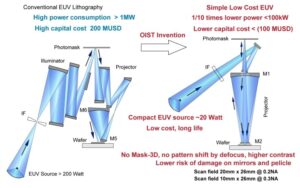
How a $400 million device — 30 years in the making — prints transistors smaller than a virus and keeps the world’s chips advancing.
Every smartphone on the planet, every laptop, every server running the internet — they all depend on a machine that most people have never heard of. That machine uses EUV lithography, or extreme ultraviolet lithography, to engrave billions of transistors onto a chip smaller than your thumbnail. Without EUV lithography, Moore’s Law — the principle that computing power doubles every two years — would have died around 2015.
There is only one company on Earth that can build the machine that makes EUV lithography work. That company is ASML, a Dutch firm headquartered in the otherwise unremarkable city of Eindhoven. Their latest EUV lithography machine costs north of $400 million, ships in 250 containers across seven Boeing 747s, and is assembled in a cleanroom where hospital-grade sterility is not even close to clean enough.
The story of how EUV lithography came to exist is one of the most extraordinary engineering journeys in human history — spanning three decades, two continents, multiple near-failures, and a handful of scientists who refused to accept that something was impossible.
What Is Moore’s Law and Why Did It Stall?
A microchip is a nanoscopic computing city. Zoom in far enough and you find skyscrapers hundreds of layers tall, connected by hundreds of kilometers of copper wires finer than a human hair. At the very bottom sit the transistors — billions of them — acting as the ones and zeros of our digital world. The smaller you make those transistors, the less distance electrons have to travel between them, making the chip faster. And by fitting more transistors in the same area, you get a more powerful chip for the same cost.
In 1965, Intel co-founder Gordon Moore noticed that the number of transistors engineers could fit on a chip doubled roughly every two years. This observation became known as Moore’s Law, and for over five decades it acted as an engine for the entire technology industry — laptops, phones, data centers, and everything in between grew exponentially more powerful almost like clockwork.
But around 2015, progress came to a near-complete halt. The physics of shrinking transistors further using existing light-based printing technology had reached a fundamental limit. Engineers had pushed deep ultraviolet (DUV) lithography as far as it could go. Without a radical new approach to printing circuits on silicon, Moore’s Law was finished — and the world’s insatiable appetite for faster, cheaper computing would have gone unsatisfied.
How Microchips Are Made: Photolithography Basics
To understand why EUV lithography matters, you first need to understand how microchips are manufactured. The process begins with silicon dioxide — essentially purified sand — which is melted and grown into a large single-crystal ingot. This ingot is sliced into thin, perfectly polished discs called wafers. Each wafer then goes through a precise cycle of manufacturing steps, repeated dozens of times to build up the many layers of a chip.
The four essential steps are: coat, expose, etch, and deposit. First, the wafer is coated with a light-sensitive material called photoresist. Then, light is shone through a patterned template called a reticle or mask onto the coated wafer. Where light hits the photoresist, it becomes chemically weakened. A chemical rinse washes away the weakened areas, leaving the design imprinted. Etching then removes material from uncovered regions, and metals like copper are deposited into the resulting channels to create the chip’s wiring.
This entire process — photolithography, the writing-with-light step — is repeated for every layer of the chip. A modern chip might require anywhere from 10 to over 100 such layers. Each layer demands perfect alignment with the layers below it. And the key constraint governing how small the printed features can be is the wavelength of the light used to expose the photoresist. This is where the fundamental limits of chip-making live, and this is where EUV lithography enters the story.
The Wavelength Problem That Nearly Ended Progress
When you try to print features whose size approaches the wavelength of the light you are using, something physically unavoidable happens: diffraction. Light bends around edges and gaps in the reticle, causing the illuminated pattern on the wafer to blur and smear. This is not a flaw in the machine — it is a consequence of the wave nature of light, governed by the Rayleigh equation, which relates the smallest printable feature size to the wavelength of the light and the numerical aperture of the optical system.
The Rayleigh Equation: The Hard Limit of Photolithography
The Rayleigh equation states: Critical Dimension ∝ Wavelength / Numerical Aperture. To print smaller features, you either need a larger numerical aperture (up to a physical maximum of 1.0) or a shorter wavelength of light. Since numerical aperture has a hard ceiling, reducing wavelength is the only path to continued miniaturization.
The industry used 248nm, then 193nm deep ultraviolet light. Multi-patterning tricks squeezed more life from 193nm tools, but by 2015, they had reached their limit. The only way forward was a drastically shorter wavelength — which meant EUV lithography at 13.5 nanometers, more than 14 times shorter than DUV.
Switching to a 14-times shorter wavelength sounds straightforward in principle. In practice, it introduced a cascade of nearly unsolvable engineering problems that caused almost every company in the world to give up on EUV lithography for decades.
The Birth of EUV Lithography: Kinoshita’s Crazy Idea
The seed of EUV lithography was planted in Japan in the early 1980s, when scientist Hiroo Kinoshita proposed using x-ray-range light — around 10 to 14 nanometers — for chip printing. The theoretical advantage was enormous. The practical problems were also enormous.
Light at these wavelengths — which we now call extreme ultraviolet or EUV — is absorbed by virtually every material it touches. Glass lenses? Absorbed completely. Air? Absorbed. The solution that Kinoshita eventually adopted was a system using curved reflective mirrors instead of transmissive lenses, operating in a near-perfect vacuum. But this too came with a critical challenge: you cannot use ordinary mirrors to reflect EUV lithography light. The surface must be engineered at the atomic level.
Kinoshita’s 1985 Demonstration — And the Disbelief That Followed
In 1985, Kinoshita’s team successfully printed lines 4 microns wide using three curved multilayer mirrors reflecting 11-nanometer light — a world first for what would become EUV lithography. When he presented his findings to the Japanese Society of Applied Physics in 1986, the audience was openly hostile. Scientists accused him of fabricating results. He later recalled that people “tended to regard the whole thing as a big fish story.”
The skepticism was not entirely unreasonable. The challenges were genuine and enormous. But Kinoshita refused to abandon the idea, and his persistence would eventually be vindicated by an entire industry.
Across the Pacific, at Lawrence Livermore National Laboratory in California, physicist Andrew Hawryluk was working on the problem from a different angle. The lab, famous for nuclear weapons research, was using multilayer mirrors to study x-rays emitted during fusion reactions. When a visiting Cornell professor challenged Hawryluk to find a practical use for this technology, Hawryluk spent ten days writing a white paper proposing the application of these mirrors to EUV lithography for chip manufacturing.
His conference presentation was met with open mockery. Every senior scientist in the room lined up at the microphone to explain why EUV lithography was impossible. Hawryluk flew home and told his boss he would “never speak of it again.” Three days later, he received a phone call from Bell Labs. The Executive Vice President of AT&T wanted him to fly out and present the idea. The journey to making EUV lithography real had begun.
The Smoothest Objects in the Universe
One of the defining challenges of EUV lithography is the requirement for mirrors of almost incomprehensible smoothness. When light scatters off a rough surface, the reflected beam spreads in all directions — useless for precise printing. For visible light, a household mirror is perfectly adequate. But EUV lithography light has a wavelength roughly 40 times shorter than visible light, which means the mirrors must be 40 times smoother.
These mirrors are built using a technique called multilayer coating — stacking alternating thin layers of silicon and molybdenum, each deposited with atom-by-atom precision. When EUV lithography light hits one of these multilayer mirrors at the correct angle, constructive interference between reflections from each layer adds up to reflect approximately 70% of the incoming light — close to the theoretical maximum and essentially the only way to reflect EUV lithography wavelengths at all.
ASML’s optical partner, Zeiss, is responsible for manufacturing these mirrors. The sputtering process used to deposit the layers inherently creates microscopic bumps and gaps. To flatten them, engineers developed a technique of bombarding the deposited layers with an ion beam, gently nudging misplaced atoms into the voids until the surface achieves atomic-level flatness.
Even with these ultra-smooth mirrors, a critical problem remains: after reflecting off six mirrors and the reflective reticle, only about 8% of the original light reaches the wafer. Every photon lost is wasted power. This means the EUV lithography light source must be extraordinarily powerful to compensate — and building that source was the hardest engineering challenge of them all.
How ASML Conquered the Chip World
ASML began life in 1984 as a spinoff from Philips in Eindhoven, starting with little more than a borrowed shed and a barely functional lithography machine. Most people inside the semiconductor industry viewed the young company as an unlikely challenger to established giants. But Philips gave ASML something more valuable than equipment: people. Among them was Martin van den Brink, who would become ASML’s CTO and the most relentless champion of EUV lithography in the industry.
By the early 1990s, ASML had joined the US EUV consortium — a collaboration between national laboratories and private companies, funded initially by Intel, Motorola, AMD, and others, that pooled $250 million to keep EUV lithography research alive after the US government cut funding in 1996. When every other American company eventually walked away from developing a full EUV lithography machine, ASML stepped forward to take on the task alone.
| Generation | Numerical Aperture | Min. Feature Size | Source Power | Wafers / Hour |
|---|---|---|---|---|
| ETS (2000) | — | 70 nm | 9.8 W | ~10 |
| NXE Low-NA | 0.33 | 13 nm | 250 W+ | ~125 |
| EXE High-NA | 0.55 | 8 nm | 500 W+ | ~185 |
ASML made a bet that many considered reckless: in 2012, when the company still had not solved the power source problem for its current generation of EUV lithography machine, it began investing in the next generation — the high-NA machine — simultaneously. As one ASML engineer recalled: “There was this crazy idiot working on the next generation where we could not even make the EUV light in the first place.” That bet ultimately paid off, but it required outside investment to sustain.
Intel invested $4.1 billion in ASML. Samsung and TSMC together contributed another $1.3 billion. The message was clear: the entire semiconductor industry needed EUV lithography to survive, and ASML was the only company that could deliver it.
Tin Droplets and Artificial Suns
The heart of every EUV lithography machine is its light source, and the light source is where the most extraordinary engineering in the entire machine happens. Generating 13.5-nanometer EUV lithography light requires creating plasma hotter than 220,000 degrees Celsius — roughly 40 times hotter than the surface of the sun. The only practical method is laser-produced plasma: firing an ultra-high-powered laser at a target material to instantly vaporize it into a plasma that radiates EUV lithography light as it cools.
Why Tin? The Surprising Choice Behind EUV Lithography
Early EUV lithography prototypes used xenon gas as the target material for plasma generation. The problem was that xenon had a conversion efficiency of only 0.5% — most of the laser energy went into making light at wavelengths the mirrors could not reflect. Tin, by contrast, has a natural emission peak at almost exactly 13.5 nanometers, the same wavelength the multilayer mirrors are optimized to reflect. This gives tin a five to ten times better conversion efficiency than xenon, making it the foundation of every modern EUV lithography light source.
But using tin introduces its own severe problems. After each plasma explosion, debris from vaporized tin spreads outward in all directions. Thirty centimeters away from the plasma zone sit the ultra-smooth, ultra-expensive collector mirrors. A single nanometer-thick coating of tin debris would ruin a collector mirror that took months to manufacture and costs millions of dollars. The EUV lithography machine needs to run continuously for a year without the collector mirror being taken offline for cleaning.
ASML’s solution was to fill the chamber with low-pressure hydrogen gas. The hydrogen slows and cools debris particles before they reach the mirror. Any tin that does land on the collector reacts with hydrogen to form stannane gas, which is pumped out — effectively making the machine self-cleaning during operation. The flow rate of hydrogen had to be calibrated with extraordinary precision: too little and the mirrors accumulate debris, too much and the hydrogen itself absorbs EUV lithography light and causes overheating.
To determine the right parameters, engineers discovered they needed to model the shockwave produced by each plasma event using the Taylor-von Neumann-Sedov formula — a mathematical framework originally developed to describe nuclear explosions and supernovas. Each plasma event in an EUV lithography machine is, in the most literal physical sense, a miniature supernova occurring 50,000 times every second.
The Pancake Technique: How ASML Cracked the Power Problem
For years, ASML’s EUV lithography light source was not powerful enough because the dense tin droplets absorbed much of their own emitted light. The breakthrough came from hitting each droplet not once but twice. A low-power pre-pulse strikes the spherical tin droplet and flattens it into a thin pancake shape, increasing its surface area while reducing density. A second, high-power main pulse then vaporizes the entire pancake at once — producing far more EUV lithography light from the same laser energy with much less debris. Modern machines use three pulses total, extracting even more light from each droplet.
Inside the $400 Million EUV Lithography Machine
The complete EUV lithography machine is one of the most precisely engineered objects humanity has ever constructed. The light source alone — the tin droplet generator, laser amplifier system, and collector mirror — is the size of a large van and requires a 20,000-watt carbon dioxide laser, amplified through four separate stages, to drive it. This laser is four times more powerful than industrial lasers used to cut steel.
After the collector mirror focuses the EUV lithography light, it passes through a set of illuminator mirrors that shape and homogenize the beam before it strikes the reflective reticle carrying the circuit pattern. The patterned light then enters the projection optics box — a hermetically sealed assembly of six ultra-smooth mirrors that shrinks the reticle image onto the wafer. The high-NA machine achieves eight times reduction vertically and four times horizontally, enabling the printing of features as small as 8 nanometers.
Mirror Control at Pico-Radian Accuracy
Because the mirrors absorb heat from the intense EUV lithography light, they expand slightly, shifting the optical path. To compensate, Zeiss embedded a robotic sensor network directly inside the optical assembly — measuring the position and angle of each mirror down to the nanometer in position and the pico-radian in angle. To visualize a pico-radian: place a laser on one of these mirrors, aim it at the Moon 380,000 kilometers away, and the pointing accuracy is precise enough to hit either edge of a coin.
The wafer stage moves the silicon wafer beneath the focused light while the reticle stage scans the circuit pattern above. To print 185 wafers per hour, the reticle must whip back and forth at accelerations exceeding 20 Gs — more than five times the peak acceleration of a Formula 1 car at full braking. And throughout all this high-speed motion, the overlay accuracy — how precisely each new layer aligns with the ones already printed — must remain within one nanometer. That is five silicon atoms of tolerance, maintained while the machine is vibrating, heating up, and running at full industrial speed.
The EUV lithography machine is assembled in an ISO Class 1 cleanroom where no more than 10 particles larger than 0.1 microns are permitted per cubic meter. Hospital operating theaters, considered extremely sterile environments, allow up to 10,000 such particles per cubic meter. The entire machine is then disassembled, packed into 250 shipping containers loaded onto 25 trucks and seven Boeing 747 cargo aircraft, and reassembled at the customer’s facility. It requires approximately 5,000 supplier companies, 100,000 individual parts, 3,000 cables, 40,000 bolts, and two kilometers of hosing.
The Legacy of EUV Lithography
The first commercial EUV lithography machines began shipping in 2016. By 2019, the first chips manufactured with EUV lithography appeared in consumer products. Today, every advanced chip from TSMC, Samsung, and Intel — including the processors in iPhones, the chips powering AI data centers, and the semiconductors running the global financial system — is made using EUV lithography. There is no alternative. ASML is the sole supplier of EUV lithography machines on Earth.
“The reasonable man adapts himself to the world. The unreasonable one persists in trying to adapt the world to himself. Therefore, all progress depends on the unreasonable man.”
— George Bernard Shaw, cited in reference to Kinoshita, Hawryluk, and the EUV lithography pioneers
The story of EUV lithography is, at its core, a story about unreasonable persistence. For thirty years, a small number of scientists and engineers refused to accept that the machine was impossible. They were laughed off stages. Their funding was cut. Their customers ran out of patience. Their colleagues told them to move on. And yet the laws of physics said that EUV lithography should work — if only the engineering could be figured out. So they kept figuring.
The next frontier is already under development. ASML’s high-NA EUV lithography machine, with a numerical aperture of 0.55, is now shipping. It can print features as small as 8 nanometers — smaller than the width of 20 silicon atoms. And ASML is already planning the generation after that. The light source roadmap targets 100,000 tin droplets per second, already demonstrated in the laboratory. The mirrors are being made smoother still.
30 Years From Idea to Industry
Japanese scientist prints 4-micron lines using curved multilayer mirrors. Audience refuses to believe it.
Hawryluk is laughed off stage, then immediately contacted by AT&T’s EVP. US national lab consortium begins forming.
First working EUV prototype proves concept but only prints 10 wafers/hour. Needs 10× power increase.
Despite unresolved power issues with current EUV machine, ASML begins development of next-generation high-NA system.
Pancake pre-pulse technique solves the density problem. Source hits 100 watts. Goalposts move to 200 watts.
ASML begins shipping commercial EUV lithography machines. Every advanced chip fab in the world is a customer.
The geopolitical significance of EUV lithography is now widely understood by governments. Because ASML is the sole manufacturer of EUV lithography machines, and because every advanced chip depends on them, control over the supply of these machines has become a key lever in technology competition between nations. The Netherlands, the United States, Japan, and other allied governments have placed export restrictions on EUV lithography machines — recognizing that whoever controls access to EUV lithography controls, to a significant degree, the pace of global technology advancement.
Conclusion: The Machine That Makes the Modern World
Every time you unlock your phone, stream a video, or search the internet, you are the beneficiary of EUV lithography. The transistors processing your commands — billions of them, each smaller than a coronavirus — exist only because a handful of scientists refused to accept the word “impossible” and because ASML spent thirty years and billions of dollars engineering what most of the world said could never be built.
EUV lithography is a reminder that the history of technology is not a smooth upward curve — it is a series of crises, breakthroughs, funding battles, public humiliations, and moments of stubborn faith in the laws of physics. Kinoshita was laughed off stage in 1986. Hawryluk was told in 1988 that his idea was “stupid.” ASML was crucified at conferences for making promises it couldn’t keep. And yet EUV lithography works. It works reliably enough to run 24 hours a day, 365 days a year, printing the circuits that run civilization.
The next generation of EUV lithography is already being built. The challenges ahead — printing features at 5 nanometers, 3 nanometers, and beyond — are no less daunting than the ones that have already been overcome. But given the track record of the people who built this machine, that seems like exactly the right kind of problem to bet on.
Where is the Center of the Universe? Is the Origin of the Big Bang Right Above Your Head?
How to Stop Over thinking and Think Deeper