Environment & Green Tech
The Artificial Tree Revolution : How India’s New Liquid Trees Are Changing the Fight Against Air Pollution
Picture this: You’re stuck in Delhi traffic, windows rolled up, air purifier humming — and you’re still half-convinced you’re slowly losing years off your life with every breath. If you live in any major Indian city, that’s not paranoia. That’s basically Tuesday.
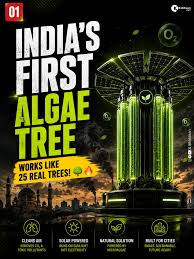
Now imagine a glowing, glass-panelled artificial tree installed right there on the pavement — silently pulling pollution out of the air, pumping out oxygen, and doing the work of 25 real trees in a fraction of the space. Sounds like something from a science fiction film, doesn’t it?
It’s not. It’s already happening — right here in India.
In 2026, India installed its very first liquid tree — officially called an algae photobioreactor — in Bhopal’s Swami Vivekananda Park. And honestly, from the moment I heard about it, I couldn’t stop thinking about what this means for cities like Delhi, Mumbai, Kolkata, and Chennai. Let’s dig into everything: what this artificial tree actually is, how it works, why it matters, and whether it can genuinely save us from ourselves.
Wait — What Exactly Is an Artificial Tree?
Let’s clear up a common point of confusion right away, because when people first hear the term “liquid tree,” they picture something out of Avatar. The reality is actually more fascinating than that.
An artificial tree — or more precisely, an algae-based photobioreactor — is a machine designed to mimic (and outperform) the air-cleaning function of a real tree. It doesn’t have bark, roots, or leaves. What it does have is a transparent glass or acrylic panel filled with water and algae — that greenish slime you’ve probably seen on ponds, walls, and monsoon-soaked pavements.
Yes. That slime. The stuff we’ve always looked at with mild disgust. Turns out it’s one of the most efficient CO₂ absorbers on the planet.
The concept isn’t brand new — Serbia installed a similar version a few years back and got impressive results. But India’s adoption of this technology is a big deal, because the scale of our pollution problem demands equally big solutions.
India’s Air Quality Problem — Let’s Not Sugarcoat It
According to a report from early 2026, India ranks as the sixth most polluted country in the world. That’s not a stat you want to be proud of. In cities like Delhi, the Air Quality Index (AQI) regularly blasts past 500 — which is the upper limit of what most monitoring systems can even measure. Whatever’s happening above that threshold? We genuinely don’t know.
Children. Elderly people. Anyone with a respiratory condition. They suffer the most. Every winter, hospitals overflow with patients dealing with aggravated asthma, bronchitis, and other pollution-related illnesses. The healthcare system creaks under the load. And beyond health — economists estimate that poor air quality costs India billions in lost productivity every year, as workers fall sick or lose working days.
The worst part? Conventional solutions — planting more trees, enforcing emission standards, pushing electric vehicles — are working, but slowly. Too slowly, in a country where urbanisation is happening at breakneck speed.
That’s the gap this artificial tree technology is trying to fill.
How Does the Liquid Tree Actually Work? The Science, Made Simple
Okay, here’s where it gets really interesting — and I promise I’ll keep it as jargon-free as possible.
The artificial tree works on a principle called photobioреaction — basically, using light and algae together to replicate (and supercharge) photosynthesis. Here’s the step-by-step:
- Air gets pumped in: A small electric pump at the base of the unit continuously draws in surrounding air — pollution and all — and circulates it through the algae-filled liquid chamber.
- Photosynthesis happens: The algae in the chamber absorb CO₂ from that air during photosynthesis, converting it into biomass (think of it as algae “eating” the carbon).
- Oxygen gets released: Clean oxygen is released back into the surrounding environment — right where people are breathing.
- Particulate matter gets filtered: The unit also traps fine particulate matter — PM 2.5 and PM 10 particles — which are the tiny pollutants that burrow deep into your lungs and cause serious long-term damage.
- Solar panel keeps it running: A solar panel on top provides electricity to power the pump and, when sunlight isn’t enough, to power artificial lighting that keeps the algae photosynthesising even at night.
The effective radius? About 10 to 15 metres around each unit. That might sound modest, but imagine a street with these units placed every 20–25 metres. You’d essentially be walking through a continuous corridor of cleaner air.
What Happens to the Algae When It Gets “Full”?
This is a question I kept wondering about — what happens to all that biomass the algae produce as they absorb CO₂? You can’t just let it pile up.
Here’s the clever part: when the algae chamber is cleaned out, the collected biomass is used as biofertiliser. It can go straight into urban gardens, parks, or agricultural fields. So not only does the artificial tree clean the air, it also produces a useful agricultural by-product. That’s a circular economy win right there.
India’s First Installation: What’s Happening in Bhopal
The pioneering installation in India was set up at Swami Vivekananda Park in Bhopal, by an organisation called Mushroom World Group. It’s the first of its kind on Indian soil — and depending on how the pilot project performs, it could become a template for cities across the country.
Bhopal is an interesting choice for a pilot, given its history with environmental disaster. There’s something quietly powerful about the idea of this city now being home to one of India’s most forward-looking clean air innovations.
The unit looks nothing like a conventional tree, by the way. Think: a rectangular glass panel, mounted vertically, filled with algae-rich greenish water, with a solar panel canopy on top and a pump housing at the base. It’s actually kind of striking to look at — and it’s already attracting curious locals who want to know what on earth it is.
Artificial Tree vs. Real Tree: An Honest Comparison
Look, I’m a huge advocate for planting real trees. Always have been, always will be. And I think it’s important to be clear: this technology is not meant to replace natural forests or street trees. Let me be very direct about that.
But for urban environments where space is scarce, soil is compacted and polluted, and air quality is at crisis levels, the artificial tree has some genuinely compelling advantages:
| Feature | Artificial Tree (Photobioreactor) | Real Tree |
|---|---|---|
| CO₂ absorption capacity | Up to 25× more per unit area | Baseline (1×) |
| Space required | Very small footprint | Needs soil, root space |
| Time to effectiveness | Immediate (once installed) | Years to decades to mature |
| Works at night? | Yes (via stored solar power) | No photosynthesis after dark |
| PM 2.5 / PM 10 filtration | Yes | Partial (via leaf surfaces) |
| Soil health benefits | No | Yes (significant) |
| Biodiversity support | No | Yes (birds, insects, etc.) |
| Biofertiliser by-product | Yes (algae biomass) | No |
| Helps with heat waves? | Partially (localised) | Yes (shade, evapotranspiration) |
| Maintenance required | Yes (regular cleaning) | Yes (watering, pruning) |
The conclusion? These two approaches aren’t in competition — they’re complementary. The artificial tree does what a real tree can’t in dense urban settings. The real tree does what a machine never can for ecosystems and biodiversity.
A Beginner’s Guide to Understanding Photobioreactors
If you’re coming to this fresh — maybe you’ve never heard the word “photobioreactor” before and you’re wondering what kind of rabbit hole you’ve wandered into — this section is for you.
Step 1: Understand Algae
Algae are simple, plant-like organisms that photosynthesise — meaning they use sunlight and CO₂ to produce oxygen and organic matter. They’re incredibly efficient at this. Per unit of surface area, algae can absorb far more carbon dioxide than even the most productive trees.
Step 2: Understand the Bioreactor
A bioreactor is basically a controlled environment where biological processes are optimised. In this case, the “reactor” is the transparent chamber filled with algae-rich water. By controlling light exposure, temperature, and airflow, you can maximise the rate of photosynthesis — making the algae work far harder than they would in a natural pond or ocean.
Step 3: Understand the System
Put it all together: pump dirty air in → algae absorbs the CO₂ → oxygen flows back out → biomass is harvested for biofertiliser → solar panel powers the whole loop. Simple concept, impressive results.
Step 4: Understand the Scale
A single artificial tree unit might seem modest. But urban planning is about density and repetition. Ten units on a busy street. A hundred across a city. The cumulative effect starts to become genuinely meaningful at city scale.
Beyond Delhi : Where Else in India Could This Work?
The obvious answer is: basically any major Indian city with serious air quality issues. But let’s think about this more specifically.
- Delhi: Ground zero for India’s air pollution crisis. Dense, traffic-choked, and surrounded by crop-burning zones. If any city needs a network of artificial trees on every major street, it’s Delhi.
- Mumbai: Coastal humidity plus vehicle emissions make for a complex pollution cocktail. Algae thrives in humid conditions, which is a natural advantage here.
- Kolkata: One of India’s oldest urban centres, with aging industrial areas still contributing to poor air quality. Compact installation options could help in the city’s dense lanes.
- Lucknow, Patna, Gorakhpur, Allahabad: North Indian cities that suffer severely during winter smog season, when temperature inversions trap pollutants close to the ground. Exactly the kind of crisis this technology was built for.
- Indore: Already one of India’s cleanest cities in terms of solid waste management — adding this technology could reinforce its clean-city brand.
One thing worth noting: the technology could also play a role in managing India’s brutal summer heat waves (loo). The units produce moisture and improved local air quality, which can have a modest cooling effect in immediate surroundings — not a replacement for urban forests, but a valuable addition.
Pro Tips for Advocates and Urban Planners
Common Mistakes to Avoid
A Small Story : The Day I Realised What Clean Air Actually Feels Like
I grew up in Nashik — which, by Indian standards, has reasonably decent air quality compared to the big metros. But I spent a few years working in Delhi in my late twenties, and I still remember the first winter I was there.
I stepped outside one November morning and the air tasted metallic. Not figuratively — literally, like licking a coin. By December, I was buying N95 masks in bulk. By the second winter, I’d become one of those people who checks the AQI app before deciding whether to go for a run.
The thing is, you stop noticing it after a while. You adapt. And that’s actually the scariest part — because your body shouldn’t be adapting to air that’s actively damaging you. You should be demanding better.
When I moved back to Nashik and stepped off the bus on a clear morning, I took a deep breath and nearly started crying. That’s not an exaggeration. Clean air — genuinely clean air — felt like a luxury I hadn’t realised I’d been missing.
Nobody should have to feel that way about breathing. That’s what makes technologies like the algae photobioreactor feel so important to me, beyond the science and the statistics. It’s about giving people back something they never should have lost.
The Bigger Picture: Urban Innovation in India
What excites me most about the liquid tree / artificial tree project isn’t just the technology itself — it’s what it represents. India has long been seen (partly fairly, partly unfairly) as a country that talks about environmental issues but struggles to act decisively on them.
This installation in Bhopal signals something different. It says: we’re not just going to wait for global solutions to trickle down. We’re going to pilot, iterate, and scale our own answers.
The fact that an organisation like Mushroom World Group took the initiative here — rather than waiting for a top-down government mandate — is also encouraging. Innovation at the grassroots and organisational level, supported by government interest, is exactly how durable change happens.
If this pilot is successful — and the early indicators are promising — we could see a national rollout across major urban centres within the next five to seven years. That’s an ambitious timeline, but not an impossible one.
For those of you writing UPSC Mains answers or general knowledge essays: this is a genuinely great example to cite when discussing innovative Indian solutions to urban environmental challenges. The technology, the mechanism (photobioреaction), and the specific Bhopal installation are all worth knowing about in detail.
Frequently Asked Questions
1. Is an artificial tree the same as a fake decorative tree?
Not at all. When we talk about an artificial tree in the context of green technology, we mean a device — specifically an algae-based photobioreactor — engineered to perform the air-cleaning functions of a real tree, but far more efficiently. It has nothing to do with plastic or fabric decorative trees used in interior design.
2. How much does it cost to install and maintain one of these units?
Exact pricing for India-specific deployments isn’t publicly available yet, as the technology is in the early pilot phase. Similar installations in Europe (like Serbia’s version) have been reported to cost in the range of a few thousand euros per unit. As manufacturing scales up and local components are sourced in India, costs are expected to come down significantly. Maintenance primarily involves regular algae harvesting and chamber cleaning.
3. Can a single artificial tree unit really make a difference in a city like Delhi?
A single unit covers a radius of about 10–15 metres — so no, one unit won’t transform Delhi’s air quality. But that’s not how urban infrastructure works. Think of it like streetlights: one lamp doesn’t illuminate a city, but thousands of them do. If artificial trees were installed at regular intervals along Delhi’s busiest roads and public spaces, the cumulative effect would be substantial. This is a density and distribution problem, not a technology problem.
4. What kind of algae is used, and where does it come from?
The specific algae strains used in photobioreactors are typically microalgae — tiny, single-celled or colonial organisms that are extremely efficient at photosynthesis. Common choices include species like Chlorella and Spirulina, both of which are well-studied and easy to cultivate. In India’s warm climate, cultivating suitable algae strains locally would be both feasible and cost-effective at scale.
5. Does the algae bioreactor work during the night or in winter?
Yes — this is one of the key advantages over real trees. The solar panel on top of the unit stores energy during the day, which is then used to power artificial lighting inside the chamber at night. This allows photosynthesis (and therefore CO₂ absorption and oxygen production) to continue around the clock. In winter, the algae may grow more slowly in very cold conditions, but the unit continues to function — albeit at slightly reduced efficiency.
6. Is this technology being adopted in other countries too?
Yes. Serbia installed a version of this technology — sometimes called the “Liquid 3” — a few years ago, and it attracted significant international attention. Several European cities have been exploring similar photobioreactor-based urban installations. India’s adoption is part of a broader global recognition that conventional approaches to urban greening aren’t sufficient to meet the scale of modern air quality challenges.
7. What’s the environmental impact of manufacturing these units?
Like any manufactured technology, there’s an embodied carbon cost to producing the glass, metals, and electronics that go into each unit. This is a legitimate consideration. However, given the CO₂ absorption rates over the unit’s operational lifetime, the lifecycle analysis is generally very favourable — meaning the unit absorbs far more carbon than was emitted to produce it, typically within a year or two of installation.
What You Can Do: Practical Next Steps
Whether you’re a student, a concerned citizen, an urban planner, or someone who just wants to breathe easier, here’s how you can engage with this issue:
- Share and amplify: Coverage of innovations like this is patchy. Share information about the Bhopal installation on social media and in your communities. Public awareness drives political will.
- Engage with local government: Write to your municipal corporation or your ward representative asking about plans for green tech deployments in your area. These questions matter and they get noticed.
- Support real tree planting too: Don’t let enthusiasm for high-tech solutions distract from the basics. Participate in local tree-planting drives. Advocate for urban forest policies in your city.
- Follow the Bhopal pilot: Keep an eye on news from the Swami Vivekananda Park installation. If it performs as hoped, that’s a powerful data point for national scaling. If challenges emerge, those are important learnings too.
- If you’re in education: Include this as a case study in discussions about climate tech, urban planning, and environmental science. The next generation of decision-makers is sitting in those classrooms.
Want to Go Deeper?
Explore more about urban green technology, India’s climate action efforts, and photobioreactor science.
Conclusion: This Is What Hope for India’s Air Looks Like
I’ll be honest with you — I approach most “revolutionary green tech” announcements with a healthy dose of scepticism. There’s a long history of innovations that sound transformative in a press release and then quietly disappear.
But the artificial tree / algae photobioreactor feels different to me. It’s not speculative — it’s installed and operating in Bhopal. The underlying science of algal photosynthesis is well-established and not in dispute. The engineering challenges are real but solvable. And crucially, the need is urgent.
India doesn’t have the luxury of waiting decades for air quality to improve on its own. Millions of people are breathing harmful air right now, today, as you read this. Technologies that can make a meaningful dent in that problem — even incrementally — deserve serious attention, serious investment, and serious rollout planning.
The artificial tree isn’t going to save us all by itself. But paired with real tree planting, better emission standards, cleaner fuels, and smarter urban planning, it could be a genuinely important part of the answer. And it’s kind of beautiful, in its own weird, glowing, algae-filled way.
Here’s to cleaner air. We all deserve it.

BTech in 2026: The Honest Truth Nobody Tells You Before You Enroll

Online Market War Nobody Told You About : E-Commerce vs Quick Commerce