Buying Guide · 2026
The 5 Best Smartphones Under ₹40,000 — Tested, Argued Over, and Finally Ranked
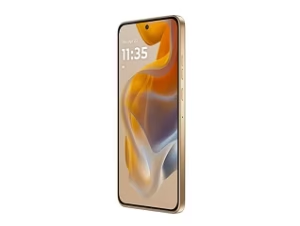
We put in the screen time so you don’t waste your money. Real testing, real opinions.
Let me tell you something I hear way too often. Someone spends ₹40,000 on a phone, uses it for three weeks, then quietly admits they wish they’d bought the other one. Not because their choice was bad — but because nobody actually sat down and explained the differences clearly before they hit that “Buy Now” button.
That’s exactly what this guide is going to fix. I’ve spent real time with all five smartphones on this list — gaming on them, shooting photos in afternoon sunlight, draining the batteries, and using them as daily drivers. No spec-sheet fluff, no brand loyalty. Just honest breakdowns of what each phone actually feels like to live with.
Whether you’re upgrading after three years on a budget device or stepping down from a flagship to save some cash, this segment is genuinely exciting right now. You’re getting flagship-grade processors, periscope zoom cameras, and 7000mAh batteries — all under ₹40,000. The market has shifted, and the value here is almost unreasonable.
So let’s get into it. Five phones, one budget, zero fluff.
Why This Price Segment Hits Different in 2026
Three years ago, spending ₹35,000–40,000 on a smartphone would get you a good phone. Today, it gets you a great phone. The kind of phone that would’ve cost ₹70,000+ just two years back.
Here’s what’s changed: chipmakers like MediaTek and Qualcomm have started making their best silicon available to mid-range devices faster than before. Brands are racing each other to win this segment, which means features like periscope zoom lenses, 1 Hz–120 Hz adaptive displays, and silicon-carbon batteries are trickling down from the ultra-premium tier at a pretty aggressive pace.
The result? You genuinely don’t need to spend ₹80,000 on a phone anymore unless you’re chasing a specific flagship experience. For most people — gamers, content creators, photography enthusiasts, everyday power users — the ₹35,000–40,000 bracket is where the real action is.
“The flagship-killer era isn’t dead — it just got better. These smartphones punch well above their price tag, and the gap between ‘affordable’ and ‘premium’ has never been thinner.”
Quick Specs Comparison: All 5 Smartphones at a Glance
| Phone | Processor | Battery | Main Camera | Price (Approx.) |
|---|---|---|---|---|
| Realme GT 7 | Dimensity 9400E | 7000mAh / 120W | 50MP + 50MP Tele | ₹36,999 |
| OnePlus 13R | Snapdragon 8 Gen 3 | 6000mAh / 80W | 50MP + 50MP Tele | ₹41,999 |
| Vivo T4 Ultra | Dimensity 9300+ | 5500mAh / 90W | 50MP + 100x Zoom | ₹35,999 |
| Samsung S24 FE | Exynos 2400e | 4700mAh / 25W | 50MP + 8MP 3x Tele | ₹39,999 |
| Nothing Phone 4a Pro | Snapdragon 7 Gen 4 | 5400mAh / 50W | 50MP + 50MP 3.5x Tele | ₹39,999 |
The 5 Best Smartphones Reviewed in Detail
Realme GT 7 Battery King
If you’ve ever ended a long day with 2% battery and mild panic, the Realme GT 7 was basically designed for you. The 7000mAh cell paired with 120W charging is a combination that feels almost unfair at this price. In our two-hour gaming test, the battery dropped just 20%. That’s not a typo.
The build borrows its design language from Aston Martin racing aesthetics — GT literally stands for that — and while the sides are plastic, they’re finished so well that even people who handle a lot of premium phones have done a double-take. Graphene back panel, IP69 protection, and Gorilla Glass 7i on the front. It’s a solid package for the money.
The display is flat 6.78-inch AMOLED running at 120Hz with a peak brightness of 6000 nits — genuinely bright enough for Indian summer afternoons. One thing to note: this is not a true 1Hz–120Hz LTPO panel, so it stays at 120Hz all the time. Not ideal for battery optimization but not a dealbreaker either, given how big that cell is.
Performance comes from the Dimensity 9400E — that’s essentially a flagship-class chip. BGMI runs at Ultra-Extreme settings at 120fps without breaking a sweat, and the max temperature we recorded during extended gaming was around 45°C. Warm, but not hot. Camera-wise, the 50MP primary and 50MP tele are competent. HDR shots can occasionally show a slight halo glow around faces, but portraits have solid subject separation and punchy colors. 8K 30fps video recording is there if you ever need to flex that spec.
- Monstrous 7000mAh battery
- 120W fast charging with charger included
- Flagship-grade Dimensity 9400E chip
- 6000-nit display brightness
- IP69 water protection
- Camera could be sharper out of the box
- Only USB 2.0 (slow data transfer)
- No true 1Hz adaptive display
- Some bloatware from Realme UI
OnePlus 13R Gaming Pick
The OnePlus 13R has been around for a bit, but here’s the thing — it’s aged beautifully. Especially now that prices on older inventory have dropped significantly. You’re looking at one of the cleanest Android experiences available at this price, running on a Snapdragon 8 Gen 3 — the same chip that powers phones costing nearly double.
OxygenOS continues to be the benchmark that every other Android skin gets judged against. It’s fast, clean, and after the OxygenOS 16 update, it still feels snappy and fresh. No weird UI animations fighting your thumbs. No unnecessary notifications from apps you didn’t install. Just a phone that does what you want, when you want.
The 1.5K LTPO AMOLED display is a genuine standout in this segment. 4500 nits peak brightness, 1600 nits for regular HDR usage, and color accuracy that holds up across the screen. Bezels are even on all four sides. Netflix, Prime Video, YouTube — everything looks sharp and bright.
Camera performance is competent rather than exceptional. Skin tones in direct sunlight tend to run slightly warm, and HDR photos are good — detailed with solid dynamic range — but they won’t make you forget the S24 FE’s camera system. The 6000mAh battery gets you 6–8 hours of screen-on time consistently. One honest note: if you’re comparing directly to the newer OnePlus 15R (around ₹50,000), the main gap is battery and some incremental upgrades. For the price difference, the 13R is often the smarter buy.
- Snapdragon 8 Gen 3 — true flagship chip
- Best-in-class OxygenOS experience
- 1.5K LTPO AMOLED display
- Alert Slider (a small joy to use)
- 3yr Android + 6yr security updates
- Camera quality can be inconsistent
- IP65 only (others offer IP69)
- Slightly above ₹40k for best variant
Vivo T4 Ultra Camera Leader
Vivo made its name on cameras. Moonlight selfies, portrait modes that made basic phones look cinematic — that legacy is alive in the T4 Ultra. But this time, they’ve added a performance backbone that makes it competitive beyond just the photography crowd.
The design is one of the more distinctive on this list. Curved glass on both front and back — rare at this price — with a shine that catches light in an almost jewelry-like way. Some people find it a bit much, but if you appreciate a phone that turns heads on a café table, the T4 Ultra delivers. The curved 6.67-inch AMOLED is smooth to swipe on; the only gripe is that curved screen protectors are always harder to find and usually less satisfying than flat ones.
Here’s the camera story: 50MP primary, 50MP 3X periscope telephoto, and an 8MP ultra-wide. That telephoto goes up to 100x zoom — 140x is the marketing number, but honestly 100x is where usable detail ends. Portrait shots at 3X have that creamy background separation that makes people think you’re using a ₹1 lakh phone. Colors are vivid, sometimes over-saturated to Vivo’s signature style, but consistency across lighting conditions is impressive.
The Dimensity 9300+ is a capable chip — BGMI runs smoothly on Extreme-Smooth settings — but it’s slightly below the 9400 tier, and you’ll occasionally notice frame drops during intense gaming. Worth knowing if raw gaming performance is your primary requirement. Battery is 5500mAh with 90W charging: solid for a day’s use, but Realme GT 7 owners will smirk.
- Best camera system in this price range
- 100x zoom periscope telephoto
- Premium curved glass build (front + back)
- 90W fast charging
- Stunning portrait and bokeh photos
- Occasional gaming frame drops
- FunTouch OS has noticeable bloatware
- Curved screen makes protectors tricky
- Battery smaller than competitors
Samsung Galaxy S24 FE Software King
There’s a reason Samsung Fan Edition phones have a genuinely passionate following. They’re not the cheapest option or the most spec-forward — but they offer something none of the others on this list can match: the full Samsung premium experience, at a price that doesn’t require selling a kidney.
The build quality is legitimately flagship. Aluminium frame, Gorilla Glass VictusPlus on front and back, 214g weight that feels deliberate rather than heavy. It looks and feels like a Galaxy S24 in every meaningful way. If you’ve ever walked into a Samsung store, held an S-series, and then stared sadly at your budget — this is your chance.
The 6.7-inch Full HD+ 120Hz Dynamic AMOLED is beautiful. Samsung’s display technology consistently ranks among the best in the industry and the S24 FE is no exception. Peak brightness at 1900 nits, accurate colors, and a panel that makes watching OTT content genuinely enjoyable.
Camera performance is where the S24 FE shines most. The 50MP main sensor, 12MP ultra-wide, and 8MP 3X telephoto are a balanced, reliable system. You can shoot HDR photos and video directly from Instagram — that’s uncommon and surprisingly useful. Portrait videos up to 4K 30fps. 8K 30fps stills. The whole system is polished in a way that some of the more spec-aggressive competitors aren’t.
Where it falls short is battery. The 4700mAh cell with 25W charging feels modest compared to everything else on this list. You’ll get through a day, but heavy users might find themselves reaching for the charger before bedtime. And at 25W, topping up takes a while. Six years of security updates and seven years of OS updates though — no other phone in this segment touches that support commitment.
- Genuine Samsung flagship build quality
- 7 years OS + 6 years security updates
- Best software experience (One UI 7)
- Full AI features from the S-series
- Excellent camera consistency
- Smallest battery on this list (4700mAh)
- 25W charging is very slow by 2026 standards
- Slightly lower AnTuTu than SD 8 Gen 3 phones
- BGMI capped at 60fps
Nothing Phone 4a Pro Most Unique
Nothing is a brand that makes you feel things. That’s a weird thing to say about a phone company, but it’s true. The Phone 4a Pro arrived after the Phone 3 (which launched at ₹80,000), and in several ways, it genuinely delivers more. We were at the London launch event for this one, and the crowd reaction told the whole story.
The glyph interface is gone — replaced by something more evolved. There’s a small circular screen on the left side of the phone with 137 mini LEDs that can show notifications, delivery tracking from Zomato or Swiggy, real-time updates, and customizable alerts. It sounds gimmicky until you’re in a crowded metro and you glance at your hand instead of unlocking your phone to check if your order has arrived. Then it clicks.
The design borrows a little from iPhone 17 Pro aesthetics around the camera island area — minimal and intentional. IP65 rated, 6.83-inch 144Hz AMOLED with 5000 nit peak brightness, and a near-flat profile that sits comfortably in your hand. The Nothing OS UI is clean, customized at the font and sound level, and has a personality that feels designed by humans who actually use phones.
Camera performance is a big step up from the Nothing Phone 3. The 50MP primary with a 50MP 3.5x periscope telephoto delivers bright, vibrant shots with good HDR processing. Selfies look natural rather than over-smoothed. 140x zoom is the headline number, but 100x is the practical ceiling for usable sharpness. Snapdragon 7 Gen 4 handles daily tasks and gaming well — BGMI runs at 120fps — but it’s below the S8 Gen 3 tier, so demanding users should keep that in mind.
- Most unique design and software personality
- Glyph-evolved mini LED display is genuinely useful
- Significantly improved camera over previous generation
- Clean, fast Nothing OS 4.1
- 7.5W reverse wireless charging
- No charger in the box
- SD 7 Gen 4 trails the top chips here
- Only 3yr Android updates
- Divisive design — love it or feel neutral
The Phone That Changed My Mind (A Personal Story)
I’ll be honest about something. When I first picked up the Samsung S24 FE, I was ready to dismiss it. I’d already spent a week with the Realme GT 7 and its absurd battery life and flagship chip, and coming to a phone with a 4700mAh cell and 25W charging felt like stepping backward.
Then I spent three days actually using the S24 FE as my daily driver. I shot photos at my nephew’s birthday party — harsh indoor lighting, kids who won’t stay still, the usual chaos. Every phone on this list would have produced decent photos. The S24 FE produced photos I immediately wanted to frame.
The skin tones were accurate. The dynamic range in the birthday cake shot — candles lit, slightly dim room, colorful background — looked like what my eyes actually saw rather than what a camera decided to render. And the next morning when I woke up to edit a few photos in the Samsung Gallery app, the experience just felt… complete.
That’s the S24 FE’s superpower. It’s not the fastest, it doesn’t have the biggest battery, and it loses the spec-sheet war easily. But it’s the most finished, most cohesive experience in the segment. Some people need that more than they need another 1000mAh of battery.
Beginner’s Guide: How to Choose the Right Smartphone for You
If you’re not a tech enthusiast and just want to know which phone to buy without reading sixteen comparison articles, here’s the shortcut.
- Start with what you do most on your phone. Photography? Go Vivo T4 Ultra or Samsung S24 FE. Gaming? OnePlus 13R or Realme GT 7. Content consumption and software quality? Samsung S24 FE. Want something that turns heads and feels different? Nothing 4a Pro.
- Battery anxiety is real — factor it in. If you’re away from a charger for long stretches during the day (travel, fieldwork, outdoor activities), the Realme GT 7’s 7000mAh cell is hard to beat. Otherwise, 5500–6000mAh is fine for most people.
- Software support matters more than people think. A phone you buy today might be with you for 3–4 years. The S24 FE’s 7-year update promise is genuinely valuable over that time horizon.
- Don’t buy just for specs you’ll never use. 8K video sounds impressive. Most people never use it. Focus on what your real daily usage looks like.
- Check for retailer offers before buying at MRP. All five phones on this list regularly go on sale during Flipkart Big Billion Days and Amazon Great Indian Sale — sometimes with bank card discounts that drop the price another ₹2,000–3,000.
- Turn off adaptive battery for the first week on any new phone to let the OS learn your usage patterns before it starts restricting background apps.
- For Vivo T4 Ultra owners: spend 10 minutes in the camera settings and dial down the “vivid” color mode to “natural” — your photos will look more realistic in daylight.
- On the OnePlus 13R, enable “Pro Mode Gaming” in the Game Space app for better thermal management during long sessions.
- Samsung S24 FE trick: use the “Expert RAW” app (free download) for significantly better low-light photos than the default camera app.
- Nothing 4a Pro: customize your Glyph alerts app-by-app in the first setup — it’s genuinely useful once each LED pattern means something specific to you.
- Buy a screen protector in-store before you leave. Curved display phones (like the Vivo T4 Ultra) need UV-applied protectors — the cheap ones bubble and peel within two weeks.
- Choosing the highest AnTuTu score phone without context. Benchmark scores don’t always translate to real-world smoothness. The S24 FE scores lower than the OnePlus 13R but the UI experience is equally fluid for daily tasks.
- Ignoring software update policy. A phone with 2 years of updates isn’t the same long-term value as one with 7 years, even if the specs look identical today.
- Buying the 8GB RAM variant when 12GB is available for a small premium — especially for gaming phones. RAM compression helps, but actual RAM still matters for multi-tasking.
- Not checking import warranty vs. Indian warranty. Some grey market listings are significantly cheaper but carry no official service center support in India.
- Falling for launch-day pricing. Every phone on this list except the Nothing 4a Pro (which is already priced competitively) has been available at ₹2,000–5,000 below MRP during sales events.
- Overlooking the charger situation. Nothing Phone 4a Pro doesn’t include one. Budget an extra ₹1,500–2,000 for a 50W GaN charger if you buy it.
Best Smartphone in Each Category — The Definitive Rankings
Best Display
OnePlus 13R and Realme GT 7 (tie) — Both have brilliant AMOLED panels with outstanding brightness. The OnePlus edges ahead on the 1.5K resolution and true LTPO panel; the Realme wins on raw brightness at 6000 nits. You honestly can’t go wrong with either.
Best Camera
Vivo T4 Ultra and Samsung S24 FE (tie) — Different strengths. The Vivo wins on zoom versatility and portrait creativity. The Samsung wins on color accuracy, overall consistency, and video quality. If you shoot a lot of portraits and landscapes: Vivo. If you want reliable shots in every condition including indoor and low light: Samsung.
Best Battery Life
Realme GT 7 — Not even close. 7000mAh with 120W charging means you can go two full days on moderate use, and a 45-minute charge gets you back to full. No other phone on this list comes close.
Best Software Experience
Samsung S24 FE — One UI 7 is polished, feature-rich, and backed by the longest update commitment in the segment. Nothing OS deserves an honorable mention for personality and uniqueness.
Best for Gaming
OnePlus 13R — Snapdragon 8 Gen 3 with clean OxygenOS means no thermal throttling during long sessions, no background interruptions during ranked matches, and the smoothest overall gaming experience on this list.
Frequently Asked Questions
If you want one answer: the Samsung Galaxy S24 FE for most people, and the OnePlus 13R for gamers and performance-first buyers. The Samsung wins on software polish, camera consistency, build quality, and long-term update support. The OnePlus wins on raw performance and display quality. There’s no single “best” — it genuinely depends on your priorities.
Yes, genuinely. Realme has improved significantly over the past two years, and the GT 7’s combination of Dimensity 9400E performance and 7000mAh battery is hard to find anywhere near this price. The camera is its weakest link, and bloatware is present in the UI — but for performance and battery value, it’s among the best deals in the segment right now.
For the ₹35,000–40,000 range, there’s always something around the corner — that’s just how smartphones work. If a specific phone on this list meets your needs today, buy it. Waiting indefinitely doesn’t pay off because each new launch tends to push prices up slightly while older models get discounted. The sweet spot is usually 2–4 months after a launch when first-batch bugs are patched and prices stabilize.
It’s a great choice, with one caveat: you need to actually appreciate design-forward thinking. If you just want the most capable smartphone spec-for-spec, the OnePlus 13R or Realme GT 7 gives you more horsepower. But if a clean, opinionated UI, the unique Glyph LED system, and a phone that genuinely feels different from everything else matters to you, the 4a Pro is rewarding to live with.
Realistically, 3–4 years for most users. The Samsung S24 FE has the longest official update support (7 years total), which means it’ll receive security and OS updates the longest. The OnePlus 13R and Realme GT 7 are on 3+4 year cycles. Hardware-wise, any of these phones will comfortably handle everyday tasks for 4+ years. The battery will likely degrade noticeably after 2–3 years of heavy use, but battery replacements are available through official service centers.
The Vivo T4 Ultra is built for visual content. The 3X periscope telephoto produces DSLR-like portrait compression, video background blur works smoothly at 4K, and the color science is tuned for vibrant, eye-catching output. If Instagram and short-form video is your primary use case, the T4 Ultra’s camera system will consistently give you content worth posting.
Final Thoughts: Here’s Exactly What I’d Buy
After spending time with all five, here’s my honest shortlist based on different buyer profiles:
- For pure value + battery: Realme GT 7 at ₹36,999. Nothing else offers this much performance and endurance at this price.
- For the best overall experience: Samsung S24 FE. Polish, camera quality, software depth, and 7 years of updates make this the most sensible long-term buy.
- For gamers: OnePlus 13R. Snapdragon 8 Gen 3 and OxygenOS is still the winning combo for sustained gaming performance.
- For camera lovers: Vivo T4 Ultra. That periscope telephoto and portrait quality in this budget is genuinely impressive.
- For those who want to stand out: Nothing Phone 4a Pro. If personality and design matter to you, nothing else on this list comes close.
Whatever you choose, you’re getting a seriously capable smartphone. This segment in 2026 is better than it’s ever been — and your money is going to go a long, long way.
Further Reading
NVIDIA Story: How a Chip Maker 30 Days from Bankruptcy Became Worth $4 Trillion
BTech in 2026: The Honest Truth Nobody Tells You Before You Enroll