Defence & Technology Blog
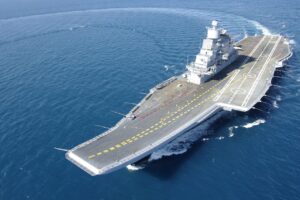
Indian Navy INS Vikramaditya : India’s Floating City of Power — Everything You Need to Know
Let me ask you something. When you hear the phrase “floating city,” what pops into your head? A luxury cruise liner? Some sci-fi movie set?
What if I told you India actually has one — and it’s armed to the teeth, capable of carrying 36 fighter jets, travels at 55 km/h across open ocean, and has been quietly protecting your coastline for over a decade?
That’s Indian Navy INS Vikramaditya for you. And honestly, most Indians don’t even know the half of what this thing can do. I didn’t either, until I started digging into the sheer scale of technology that India’s Navy has quietly been building — and it genuinely blew my mind.
In this post, we’re going deep. We’re talking aircraft carriers, AI-powered surveillance, underwater robots, laser weapons, exoskeleton suits — the full picture. Buckle up, because by the time you’re done reading this, you’re going to feel very, very proud to be Indian.
What Exactly Is INS Vikramaditya ? The Basics First
Before we get carried away with all the cool tech, let’s make sure we’re on the same page about what INS Vikramaditya actually is.
It’s India’s primary aircraft carrier — a massive warship that functions as a mobile air base in the middle of the ocean. Originally a Russian warship called Admiral Gorshkov, India acquired it in 2013 after a significant modernisation process. And I mean significant — it was practically rebuilt from the inside out.
Here’s what makes it special. Most countries have naval vessels. Very few have aircraft carriers. And those that do? They’re in a completely different league of naval power. The ability to project air power from sea, thousands of kilometres from your nearest air base, is a game-changer in modern warfare.
Quick fact: India is one of only a handful of nations in the world that operates aircraft carriers. Pakistan has zero. That strategic gap matters enormously, especially in the Indian Ocean region.
INS Vikramaditya at a Glance
| Specification | Detail |
|---|---|
| Original Name | Admiral Gorshkov (Russia) |
| Commissioned by India | 2013 |
| Length | Approx. 284 metres |
| Displacement | ~45,000 tonnes |
| Top Speed | 30 knots (~55 km/h) |
| Aircraft Capacity | Up to 36 (jets + helicopters) |
| Home Port | Karwar Naval Base, Karnataka |
| Upgrade Contract | ₹1,200 crore signed in 2024 |
INS Vikrант: India’s Own Made-From-Scratch Carrier
Now here’s where it gets genuinely emotional if you’re Indian. In 2022, India commissioned INS Vikrant — and this wasn’t acquired from anyone. Every single piece of it was designed and built right here in India. Make in India, but for real this time.
Weighing about 45,000 tonnes with a length of 262 metres and 15 decks containing over 2,300 compartments inside, INS Vikrant is essentially a small, self-contained city sailing through the ocean. It can accommodate 30 aircraft, house 1,600 crew members, and cruise at 28 knots. The total cost? Around ₹23,000 crore.
Think about that for a second. A country that was still importing fighter planes and basic defence equipment just two decades ago now manufactures its own aircraft carrier from scratch. That’s not incremental progress — that’s a quantum leap.
Here’s why having two carriers matters strategically. If China and Pakistan were ever to attempt a coordinated dual-front threat, India can now respond on both flanks simultaneously. INS Vikramaditya covers the Arabian Sea, INS Vikrant covers the eastern sector. Two floating air bases, both ready to go.
The Tech That Makes Indian Navy INS Vikramaditya Truly Lethal
Okay, here’s where things get genuinely fascinating. It’s not just the carriers themselves — it’s the entire ecosystem of technology that surrounds them that makes India’s Navy so formidable right now.
1. The Iron Man Suits Are Real (No, Seriously)
DRDO — India’s defence research organisation — along with private companies, is developing what are called exoskeletons for Navy personnel. Think Iron Man’s suit, but practical. These are wearable robotic frames that amplify a soldier’s physical strength and endurance.
Why does the Navy need this? Because working on a warship is brutally demanding. Engine rooms, ammunition handling, damage control — it involves lifting incredibly heavy loads for hours on end. These suits reduce injury, increase capacity, and effectively turn an ordinary human being into a super-human worker.
- Full-body and lower-body variants available
- Can handle 50–100 kg equipment loads with ease
- Dramatically reduces back injuries and physical fatigue
- Trials already completed in the Army; now being tested by the Navy
Combined with smart helmets that feature AI cameras, GPS, night vision, heads-up displays, and wireless comms — we’re talking about soldiers who can see in the dark, communicate silently, and carry twice the load. The tech that seemed like science fiction a decade ago is already in Indian Navy trials.
2. India’s Private Naval Internet That Cannot Be Hacked
Here’s something that genuinely surprised me. The Indian Navy has its own private internet. It’s called NUD — Naval Unified Domain. This isn’t a metaphor. It’s a dedicated encrypted network that connects every single asset the Navy operates.
- 140+ warships
- 19 submarines
- Both aircraft carriers
- Three major naval bases: Mumbai, Kochi, and Visakhapatnam
Everything runs on this network, all connected through the GSAT-7 satellite, covering 7.5 million square kilometres of ocean. Data transfer speeds exceed 100 Mbps and uptime is 99.99%. What does that mean in plain English? The network never goes down.
And because it’s end-to-end encrypted, no neighbouring country can intercept or hack the communications. The moment one ship detects an enemy vessel, an instant alert goes out across the entire fleet. That kind of real-time networked awareness changes everything in a conflict scenario.
How GSAT-7 Powers the Fleet
- Dedicated military satellite for the Indian Navy
- Covers the entire Indian Ocean region
- Supports secure voice, data, and video communication
- 100+ Mbps speeds with near-zero downtime
- Submarines also use underwater acoustic tech to communicate while submerged
3. AI That Watches the Ocean 24/7
Remember the days when border security meant soldiers with binoculars? Those days are well and truly over.
The Indian Navy now uses an AI-powered system called ANWESH — which continuously monitors the Indian Ocean using satellite imagery and ship cameras. 24 hours a day, 7 days a week. It uses pattern recognition to identify enemy ships, submarines, smugglers, and pirates. And when it finds something suspicious, it doesn’t just raise an alert — it locks on and feeds targeting data directly to missile guidance systems.
There’s also PROTON — Processor for Real-Time Optical Network — an AI image processing system installed across ships, submarines, and aircraft. Combined with the electronic warfare suite called Shakti, which can detect enemy radar signals, jam missiles, and even fingerprint individual enemy radars (like a unique ID for each radar system), the Navy essentially has an invisible defensive shield around its fleet at all times.
4. Submarines That Can Hide for Weeks
India’s submarine fleet is getting a serious upgrade, and it involves two game-changing technologies.
The first is AIP — Air Independent Propulsion. Traditional diesel submarines have a major weakness: they need to surface every two or three days to run their engines and refuel on oxygen. In enemy waters, that surfacing window is when they’re most vulnerable to radar and sonar detection. AIP fixes this by generating electricity from hydrogen and oxygen — essentially making electricity from water. With AIP, submarines can stay submerged continuously for two to three weeks. Nobody knows they’re down there.
The second technology is lithium-ion batteries. Under Project 75i, India is acquiring six submarines from Japan — the first in the world to use this technology. These batteries store three times more energy at the same weight, charge in four to six hours, and can push a submarine to 25 knots in emergency sprint mode. That’s faster than some surface vessels.
Weapons That Would Make Any Adversary Think Twice
Let’s talk about what happens when India’s Navy actually needs to go on the offensive — because the weapons systems are nothing short of extraordinary.
BrahMos: The Missile That Went Through a Ventilation Duct
You might’ve heard about this during Operation Sindoor. During strikes on a fortified terrorist base in Pakistan — a concrete structure specifically built to resist missile penetration — a BrahMos missile was guided through a ventilation duct opening roughly a foot wide, entered the room, and detonated inside.
A foot wide. A supersonic cruise missile. Through a ventilation hole.
BrahMos is India’s own supersonic cruise missile, jointly developed with Russia, and it’s considered one of the most accurate anti-ship and land-attack missiles in the world. The precision it demonstrated in that strike isn’t just impressive — it’s the kind of capability that fundamentally changes how an adversary calculates the cost of conflict.
Varunastra: The Submarine Hunter
Varunastra is India’s heavyweight torpedo designed specifically to hunt and destroy enemy submarines at depth. Entirely indigenously developed, it’s one of the most sophisticated anti-submarine weapons in Asia. The name itself means “Water Weapon” in Sanskrit — and it lives up to that name.
High Energy Laser Weapons: Shooting with Light
Here’s the one that actually made me laugh when I first read about it — not because it’s silly, but because of how absurdly cost-effective it is.
Right now in the Middle East, the US is firing $4 million missiles to shoot down $20,000 Iranian drones. That’s just brutal maths. DRDO’s laser weapon system — called HEL, or High Energy Laser — can do the same job for approximately ₹150 to ₹200 per shot. Two hundred rupees. Less than a cup of coffee at some places.
How? It uses a focused laser beam travelling at the speed of light to heat and destroy the target. No projectile, no missile, no explosive. Just energy, directed precisely. The system has already been tested at 2 kW scale and there are plans to scale it up to 100 kW, at which point it can take down drones, missiles, incoming rockets, and even damage sensors on enemy aircraft.
- Reaction time: essentially zero (light speed)
- Accuracy: extremely precise, small focused beam
- Cost per intercept: ~₹150–200
- Limitation: slightly reduced effectiveness in fog, thick haze, or heavy dust
Beginner’s Guide: Understanding India’s Naval Power
If you’re new to all of this, here’s the simplest way to understand why India’s naval strength matters in 2025:
- Aircraft Carriers = Mobile air bases. They let India project air power anywhere in the ocean without needing a nearby airstrip. India has two; Pakistan has zero.
- Submarines = Stealth threats. They operate silently underwater and can launch torpedoes or missiles. The harder they are to detect, the more powerful they are as a deterrent.
- Electronic Warfare = The invisible battle. Jamming enemy communications, detecting radar signals, confusing incoming missiles — this is warfare before a single bullet is fired.
- The Indian Ocean = India’s home turf. Over 60% of global oil trade passes through it. Controlling this ocean is one of India’s most critical strategic advantages.
- Deterrence = The whole point. The goal of all this technology isn’t necessarily to go to war — it’s to make the cost of attacking India so high that no one considers it.
Bookmark this section if you’re sharing this article with someone who’s just getting interested in India’s defence. It’s the 101 they need.
Underwater Drones: The Future Is Already Here
Here’s something the mainstream news barely covers: India is actively developing and testing autonomous underwater vehicles — basically, underwater robots — that can operate independently, for weeks at a time, without a single human on board.
HEUV — The 6-Tonne Underwater Worker
The HEUV (High Endurance Autonomous Underwater Vehicle) weighs six tonnes, dives to 300 metres, and can operate continuously for 15 days. It finds and neutralises underwater mines, and carries sonar, X-band radar, and collision avoidance systems. Trials are currently underway at Cochin Shipyard.
XLUUV — The Underwater Combatant
The XLUUV is the bigger, angrier cousin. Currently in development, it’ll weigh around 100 tonnes (with plans to scale to 500 tonnes) and will be fully armed — capable of launching torpedoes and missiles. Think of it as an unmanned submarine. It can attack enemy submarines, defend against incoming torpedoes, and complete missions that would be too dangerous for a crewed vessel.
These aren’t science fiction — they’re active projects with prototypes under development and government funding behind them. When they’re operational, they’ll fundamentally change underwater warfare in the Indian Ocean.
Operation Sindoor and What It Proved About India’s Navy
Let me tell you about a moment that sent a very clear message to the world.
When Operation Sindoor was underway, the Chief of Indian Naval Staff made a public statement that was remarkable in its directness: if hostilities escalated, Indian Navy would directly target Karachi Port.
Now think about what that means. That’s not a threat made lightly. Karachi is Pakistan’s most critical commercial and naval port. Threatening it requires the credibility to actually follow through — and that credibility comes from two aircraft carriers deployed in the Arabian Sea, a fleet of submarines that can remain undetected for weeks, BrahMos missiles with proven precision, and an AI-powered surveillance network watching every ship movement in the region.
The message wasn’t just words. It was backed by hardware that everyone in the region — and the world — could see.
Strategic context: India is the only country in the world with an entire ocean named after it — the Indian Ocean. That’s not just poetic; it reflects a geopolitical reality. India commands and patrols the world’s third-largest ocean, through which flows a significant portion of global trade, energy, and commerce.
Pro Tips: How to Stay Informed About Indian Defence Without Getting Misled
This matters more than ever in 2025, when rumours and misinformation spread faster than actual news. Here’s what I’ve learned:
- Cross-reference before sharing. A viral video of “petrol queues in Ahmedabad” or “India launching nuclear subs” doesn’t mean it’s real. Check PIB (Press Information Bureau) and official Navy/DRDO announcements before forwarding anything.
- Follow official handles. @indiannavy on Twitter/X and the Ministry of Defence’s official website are the most reliable primary sources for what India’s military is actually doing.
- Understand the difference between development and deployment. A technology being “tested” or “in trials” is not the same as it being “operational.” Both are worth knowing, but they’re very different stages.
- Don’t panic over Chinese naval movements. Yes, China has been increasing presence in the Indian Ocean. But the Indian Navy actively monitors and responds to this. That’s exactly what NUD, ANWESH, and carrier deployments are for.
- Follow credible defence journalists, not random YouTube channels with thumbnail thumbnails of glowing red backgrounds and dramatic music. You know the ones.
Common Mistakes People Make When Talking About Indian Naval Power
- Comparing India only to Pakistan. India’s Navy is increasingly designed for power projection across the entire Indo-Pacific, not just the subcontinent. The comparison should include China, and increasingly, global benchmarks.
- Dismissing older ships as obsolete. INS Vikramaditya may have been acquired in 2013, but a ₹1,200 crore upgrade contract was signed in 2024. These ships are continuously modernised, not left to age.
- Thinking “submarine” means “slow and defensive.” Modern submarines — especially those with AIP and lithium batteries — are fast, stealthy, and offensively capable. They’re not just hiding; they’re hunting.
- Assuming AI in defence is years away. ANWESH and PROTON are already operational or in advanced stages. AI in Indian defence isn’t future-tense — it’s present-tense.
- Conflating “budget” with “capability.” India’s approach to cost-efficiency (₹200 laser intercepts vs. $4 million US missiles) is actually a strategic advantage, not a weakness.
Frequently Asked Questions
INS Vikramaditya is India’s premier aircraft carrier, originally a Russian warship (Admiral Gorshkov) that was extensively modernised and commissioned into the Indian Navy in 2013. It’s important because it gives India the ability to project air power from sea — essentially a mobile air base with 36 fighters and helicopters that can operate anywhere in the Indian Ocean. It significantly elevates India’s strategic deterrence, particularly in the Arabian Sea region, and signals India’s status as a first-tier naval power.
INS Vikramaditya was acquired from Russia and modernised, while INS Vikrant — commissioned in 2022 — is India’s own indigenously designed and built aircraft carrier, the first of its kind. Both are roughly similar in displacement (~45,000 tonnes), but Vikrant represents India’s self-reliance in shipbuilding. Together, they allow India to have a two-carrier strategy, covering both the Arabian Sea and the Bay of Bengal/eastern sector simultaneously.
Yes — it’s called NUD (Naval Unified Domain). It connects all Indian Navy assets including warships, submarines, aircraft carriers, and naval bases through the GSAT-7 military satellite. The entire network is end-to-end encrypted, covers 7.5 million sq km of ocean, runs at over 100 Mbps, and has a 99.99% uptime. Submarines also use underwater acoustic communication technology to stay connected when submerged, where radio signals can’t penetrate.
AIP stands for Air Independent Propulsion. Traditional diesel submarines must surface every 2–3 days to run their engines using oxygen. This surfacing window is a major vulnerability — the submarine can be detected by radar or sonar. AIP generates electricity by combining hydrogen and oxygen (essentially producing power from water), eliminating the need to surface. Indian submarines equipped with AIP can stay continuously submerged for 2–3 weeks, making them nearly impossible to detect and track in enemy waters.
BrahMos is a supersonic cruise missile jointly developed by India and Russia. It’s one of the most accurate missiles in the world. During Operation Sindoor, a BrahMos missile was reportedly guided through a ventilation duct opening of approximately one foot in width on a fortified concrete structure — entering the room and detonating inside. This level of precision is world-class, and it demonstrates that India’s strike capability isn’t just theoretical. BrahMos can be launched from ships, submarines, aircraft, and land-based systems.
India’s DRDO-developed High Energy Laser (HEL) system costs approximately ₹150–200 per interception — compared to millions of dollars for conventional missile interceptors. The US, for instance, has been using $4 million missiles to destroy $20,000 Iranian drones in recent Middle East conflicts. India’s laser approach — drawing on existing electrical power, requiring no ammunition or propellant — is a radically cost-efficient alternative. DRDO has tested 2 kW systems and is working toward 100 kW systems with dramatically greater range and impact.
Final Thoughts: What This All Means for You
Here’s the honest truth. We live in a time when misinformation travels faster than facts. Rumours about fuel shortages, war alerts, and panic-inducing forwards spread at the speed of a WhatsApp message. The best antidote to that? Actually knowing what your country is capable of.
Indian Navy INS Vikramaditya is not just a ship. It’s a symbol of a country that went from struggling to build basic military hardware to designing its own aircraft carrier, developing laser weapons, deploying AI surveillance systems across the Indian Ocean, and training its soldiers in exoskeleton suits. That’s not propaganda — that’s a verifiable, documented transformation.
Does that mean we should be complacent? Absolutely not. India’s defence requires constant investment, constant innovation, and an informed citizenry that asks the right questions and holds leadership accountable.
But the next time someone in your family group sends a panicked forward about “India is defenceless” — send them this article instead. Knowledge is the first line of defence, and now you’re armed with it.
- Learn more — follow official DRDO and Indian Navy announcements
- Share accurately — don’t amplify rumours; amplify facts
- Stay curious — India’s defence story is still being written, and it’s remarkable
Nikola Tesla : The Forgotten Genius Who Literally Powered Your World

Isaac Newton : The Brilliant, Troubled, and Utterly Fascinating Man Behind the Science

Kailash Mandir at Ellora: The Temple Carved from a Single Mountain That Still Has Engineers Baffled