Tech · Business · AI
The NVIDIA Story: How a Chip Maker 30 Days from Bankruptcy Became Worth $4 Trillion
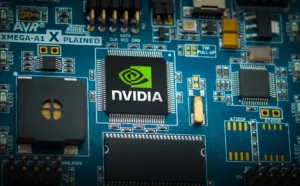
We’re living in the age of artificial intelligence, and whether you realize it or not, almost every piece of AI magic you’ve interacted with — from ChatGPT to Google’s image recognition to Tesla’s self-driving system — runs on NVIDIA hardware. The company is worth more than Apple was at its peak, more than the GDP of 185 countries, and it got there through a combination of genuine brilliance, near-death experiences, and a founder who saw the future before anyone else even knew the future existed.
This is that story. And it’s a lot more interesting than a dry stock market retrospective. So let’s get into it.
Beginner’s Guide: What Is NVIDIA and Why Does It Matter?
If you’re not deep in tech circles, you might know NVIDIA as “the company that makes gaming graphics cards.” And you’d be right — but that’s like calling Amazon “the company that delivers books.” It’s technically accurate, but it misses about 99% of the picture.
At its core, NVIDIA designs chips — specifically, a type called a GPU (Graphics Processing Unit). Here’s the simplest way to think about what a chip actually does:
Every time you unlock your phone, scroll Instagram, ask ChatGPT something, or watch a 4K YouTube video, you’re triggering millions — sometimes trillions — of tiny calculations happening faster than a blink. A chip is the thing doing all of those calculations. It’s the invisible brain behind every digital experience you’ve ever had.
Image placeholder: Close-up of a modern NVIDIA GPU chip on a green circuit board
alt=”NVIDIA GPU chip on circuit board showing processor architecture”
CPU vs GPU — What’s the Difference?
Think of a CPU (Central Processing Unit) as a highly skilled surgeon — brilliant at complex, sequential tasks, one at a time. Now think of a GPU as an army of competent assistants who can all work simultaneously on thousands of simpler tasks at once.
- CPU: Handles a few complex operations at high speed (great for general computing)
- GPU: Handles thousands of simpler tasks simultaneously (perfect for graphics, AI, and scientific simulation)
This parallel processing ability — the GPU’s defining superpower — turns out to be exactly what modern AI needs. Training an AI model is essentially doing billions of matrix multiplications simultaneously. A CPU struggles. A GPU does it like breathing.
| Feature | CPU | GPU (NVIDIA) |
|---|---|---|
| Core count | 8–64 cores (typically) | Thousands of CUDA cores |
| Task type | Sequential, complex | Parallel, repetitive |
| Best for | Operating systems, databases | Graphics, AI training, simulation |
| AI training speed | Slow | 10–100x faster |
| Key product | Intel Core, AMD Ryzen | NVIDIA H100, RTX 5090 |
The Origin Story: 1993 and a Bet Nobody Wanted to Take
Jensen Huang co-founded NVIDIA in 1993 with two friends — Chris Malachowsky and Curtis Priem. At the time, the PC revolution was just getting started, and everyone in Silicon Valley was chasing business software, server infrastructure, and enterprise tools. Games? That was kids’ stuff. VCs wouldn’t fund it. Engineers didn’t want to work on it.
But Jensen had a different read on the situation. While the industry looked at gaming and saw a toy market, he looked at it and saw a computing problem that nobody had solved yet. Games demanded speed, high resolution, and real-time physics — all at once. To run a game smoothly, a chip needed to do billions of calculations per second without breaking a sweat.
And Jensen’s insight — which turned out to be almost prophetic — was this: if you can build a chip that handles games, you can build a chip that handles anything.
So in 1993, NVIDIA set out to build the world’s first consumer 3D graphics chip. At the time, it was one of the only companies crazy enough to try.
Image placeholder: Early 1990s gaming setup showing the era NVIDIA was founded
alt=”Retro 1990s gaming PC setup representing the era when NVIDIA was founded”
The Near-Death Moment: 30 Days from Bankruptcy
The year was 1996. NVIDIA had bet everything on a chip called the NV1. It was ambitious — one chip to handle graphics, sound, and game controls all at once. Sega, the gaming giant, had partnered with them. Everything looked perfect. Until it wasn’t.
Microsoft launched DirectX — a new standard that told game developers: if your game runs on Windows, you use triangles to build everything. NVIDIA’s NV1 used a different geometric approach called quadratic surfaces. Technically interesting. Completely incompatible. Game developers abandoned NV1 overnight, because supporting it meant rebuilding their games from scratch for a platform nobody was buying anyway.
Out of 250,000 units NVIDIA had shipped, 249,000 came back. Sega quietly ended the partnership. Engineers had to be let go. The lights in NVIDIA’s office were literally dimmed to save money on electricity. Jensen was skipping utility bills just to keep paying salaries.
Thirty days of cash. That’s all they had left.
This is the kind of moment that ends companies. And most companies at that stage — out of cash, out of credibility, the entire industry pointing and laughing — they fold. They sell. They give up.
Jensen Huang did something else entirely.
The Madman’s Gamble: Build a New Chip Without Testing It
He gathered his remaining engineers and gave them a mission: build a completely new chip. Compatible with DirectX. And build it fast. In the chip world, there’s one rule that’s treated as sacred: always test before you manufacture. A chip isn’t just a piece of metal. It’s a microscopic city — billions of transistors, millions of logic gates, interconnected pathways so fine they make a spider web look industrial. One wrong connection and the whole thing fails. One misrouted logic gate and it overheats, crashes, and you’ve just mass-produced millions of expensive paperweights.
Jensen’s team didn’t have time to test. They simulated the chip in software — essentially a 3D model of the chip running virtually — and sent the design straight to TSMC for manufacturing without physical validation. If the simulation had even a nanosecond of error, the chip would be dead on arrival. And NVIDIA would be finished.
They waited eight weeks. Eight weeks of nobody sleeping properly, of engineers running and re-running mental simulations, of Jensen holding the whole thing together through sheer will.
And then the chips arrived. And they worked. Perfectly.
The Comeback: Riva 128 and NVIDIA’s Rebirth
The chip was called the Riva 128 — short for Real-time Interactive Video and Animation. Released in 1997, it was the first fully hardware-accelerated 3D rendering pipeline the world had ever seen. Game reviewers who got early access were practically speechless. Frames that used to stutter ran silk-smooth. Games that looked flat suddenly had depth.
Within four months of launch, NVIDIA had shipped one million units. More than any other chip maker in the same period. The company that the entire industry had written off was suddenly the company everyone wanted to talk to.
But here’s the thing about comebacks — they’re just the opening act if you keep pushing. And Jensen was just getting warmed up.
Image placeholder: Timeline graphic showing NVIDIA’s journey from 1993 to $4 trillion
alt=”NVIDIA company timeline from founding in 1993 to 4 trillion dollar valuation”
The GeForce Revolution and the Birth of the GPU
Two years after Riva 128, NVIDIA launched the GeForce 256 in 1999. This was the first time anyone used the term “GPU” — Graphics Processing Unit. It wasn’t just a new chip. It was a new category of computing.
Previous chips offloaded some work to the CPU. The GeForce 256 handled everything: transformation, lighting, and rendering — all on the chip itself. Game developers suddenly had a tool that could make their worlds look genuinely cinematic. And players noticed immediately.
NVIDIA didn’t just dominate the gaming chip market. It defined it. Competitors scrambled. And Jensen, characteristically, was already thinking about the next non-obvious thing.
Because Jensen always seemed to be seeing a version of the future that nobody else could quite make out yet.
CUDA: The Bet That Took Six Years to Pay Off
In 2006, Jensen made one of the boldest investments in Silicon Valley history. He took NVIDIA’s profits and poured them into building something called CUDA — Compute Unified Device Architecture. In plain English: a software platform that let developers use NVIDIA’s GPUs for anything, not just graphics.
Scientists could use CUDA to simulate disease outbreaks in seconds instead of days. Engineers could use it to model fluid dynamics for aircraft design. Researchers could use it to run computations that would have taken weeks on traditional CPUs in mere hours.
There was just one problem. In 2006, nobody needed this. AI wasn’t a thing yet. Self-driving cars were science fiction. The biggest AI models of the era were tiny by today’s standards, running on algorithms that didn’t require serious computing power. Jensen had essentially handed the world a Formula 1 engine when everyone was still riding bicycles.
For six years, CUDA sat there. Powerful. Underused. Patiently waiting for the world to catch up.
CUDA is arguably the single most important piece of technology NVIDIA ever built — not because it was revolutionary when it launched, but because it was exactly what AI researchers needed when deep learning finally took off. The six-year wait was the investment.
AlexNet, 2012, and the Day Everything Changed
September 30, 2012. A quiet research lab at the University of Toronto. Three researchers — Alex Krizhevsky, Ilya Sutskever, and their mentor Geoffrey Hinton, the man who’d later be called the “godfather of AI” — submitted an entry to ImageNet, the world’s biggest image recognition competition.
Their model was called AlexNet. It was a neural network — a type of AI architecture loosely inspired by how the human brain works. And they’d trained it on NVIDIA GPUs using CUDA.
AlexNet didn’t just win. It demolished the competition. Its error rate was nearly half that of the second-place entry. In a field where improvement was measured in fractions of a percent, AlexNet was like someone showing up to a bicycle race on a motorcycle.
The entire AI research community sat up at once. Suddenly, three things became obvious:
- Deep learning actually works — at scale, with enough data
- GPUs are the perfect hardware to train these models
- CUDA was the secret infrastructure that made all of it possible
And just like that, Jensen’s six-year gamble paid off. Google, Facebook, Tesla, OpenAI — they all came knocking. They all started training on NVIDIA hardware. The AI gold rush had started, and NVIDIA owned the picks and shovels.
Image placeholder: Visual representation of a neural network with NVIDIA GPU powering AI training
alt=”Neural network visualization showing AI training powered by NVIDIA GPU and CUDA platform”
Pro Tips: How to Actually Understand NVIDIA as an Investor or Tech Enthusiast
NVIDIA’s gaming revenue gets the headlines, but it’s the Data Center segment — selling H100 and B200 GPUs to hyperscalers like Microsoft, Google, and Amazon — that’s driving the valuation. When you see NVIDIA’s earnings, go straight to Data Center revenue. That’s the real story.
The reason NVIDIA is so hard to compete with isn’t just the hardware — it’s that the entire AI ecosystem has been built on CUDA. Hundreds of thousands of AI researchers know CUDA. Millions of lines of code are written for CUDA. Switching away from NVIDIA isn’t just an engineering challenge; it’s a cultural and institutional one.
Jensen is one of the most articulate and prescient CEOs in the tech industry. His keynotes at GTC (NVIDIA’s annual developer conference) consistently preview where computing is headed 3–5 years out. If you follow one executive’s public appearances to understand where AI is going, make it his.
NVIDIA’s consumer RTX cards and its data center H-series and B-series chips are very different products for very different buyers. The AI chips that make NVIDIA worth $4 trillion are not the same as what’s inside a gaming PC. Understanding this distinction helps you interpret the company’s financials much more accurately.
NVIDIA designs chips but doesn’t manufacture them — TSMC does. TSMC’s capacity, yield rates, and production timelines directly affect NVIDIA’s ability to fulfil orders. Following both companies together gives you a much clearer picture of the AI chip supply chain.
Common Mistakes People Make When Thinking About NVIDIA
Gaming is where NVIDIA came from, but it’s now a relatively minor part of the story. Data center AI chips represent the overwhelming majority of revenue and growth. The RTX 4090 is cool, but the H100 cluster is what’s valued at $4 trillion.
AMD, Intel, and various AI chip startups are all trying to compete. What people underestimate is that CUDA isn’t just software — it’s a decade-long ecosystem investment. Replicating the hardware is hard. Replicating the ecosystem of developers, libraries, and institutional knowledge built around CUDA is a much longer journey.
Every time NVIDIA’s stock moves dramatically, commentators call it a bubble. It might be — but it’s worth understanding why the valuation is what it is before assuming. NVIDIA has real, contracted revenue from real customers. The AI infrastructure build-out is a genuine, multi-year capital expenditure cycle by the world’s largest companies.
NVIDIA isn’t just selling hardware. It’s increasingly selling software frameworks, enterprise AI tools, and cloud services. Treating it purely as a chip company misses a significant and growing part of the business model.
With the build-out of AI infrastructure still in relatively early innings — reasoning models, agentic AI, robotics, autonomous vehicles all requiring massive compute — the demand cycle for NVIDIA chips is likely much longer than most near-term forecasts suggest.
NVIDIA Today: From Chips to the Infrastructure of Intelligence
As of 2025–2026, NVIDIA sits at the centre of the most significant technology transition since the internet. Every major AI lab — OpenAI, Google DeepMind, Anthropic, Meta AI — trains its models on NVIDIA’s hardware. Every major cloud provider — AWS, Azure, Google Cloud — rents NVIDIA GPUs to enterprise customers building AI applications.
The H100 and newer Blackwell B200 chips have waiting lists measured in months. Companies have placed orders worth billions of dollars. Governments are procuring NVIDIA hardware as strategic infrastructure, the same way they once procured military equipment.
Jensen Huang, the founder who skipped utility bills to keep his team paid in 1996, is now one of the most powerful individuals in the global technology landscape. Not because he got lucky. But because he had a non-obvious insight, held onto it through near-bankruptcy, bet everything on a product that took six years to find its market, and never stopped pushing.
That’s not a success story. That’s a masterclass.
Image placeholder: NVIDIA stock price chart showing growth from 2012 to 2025 alongside AI milestones
alt=”NVIDIA stock price growth chart from 2012 to 2025 with AI development milestones marked”
Frequently Asked Questions About NVIDIA
The hardware gap is real but not insurmountable. The deeper moat is CUDA. Every major AI framework — PyTorch, TensorFlow, JAX — is optimized for NVIDIA’s CUDA platform. Retraining millions of AI researchers and rewriting the entire software ecosystem around a different chip architecture is a multi-year project that nobody has successfully pulled off yet. The chip is the door; CUDA is the key that opened the entire room, and NVIDIA holds every copy.
CUDA — Compute Unified Device Architecture — is the software layer that lets developers use NVIDIA GPUs for general-purpose computing instead of just graphics. Launched in 2006, it unlocked the ability to run scientific simulations, AI training, drug discovery, and financial modelling on GPU hardware. Before CUDA, GPUs were for games. After CUDA, they became general-purpose supercomputers. It’s arguably the single most consequential software product in AI history that most people have never heard of.
This is genuinely contested, and honest analysts disagree. On one hand, NVIDIA has real, compounding revenue growth driven by contracted AI infrastructure spending from some of the world’s most cash-rich companies. On the other, any valuation at that scale implies continued dominance in a market where competition is intensifying and customer concentration (a few hyperscalers buying most of the chips) is a meaningful risk. It’s probably neither “obviously justified” nor “pure bubble” — it’s a real company with real demand trading at a premium that prices in a very optimistic future. Worth understanding both sides before forming a view.
Consumer gaming GPUs (the RTX series) are designed for real-time graphics — high visual fidelity, fast frame rates, consumer price points. AI training GPUs (the H100, H200, B200 Blackwell series) are designed for raw parallel computing throughput, huge memory bandwidth, and the ability to handle multi-node distributed training across thousands of chips simultaneously. The latter cost tens of thousands of dollars per unit and are sold in clusters. They share architectural DNA with gaming GPUs but are purpose-built for a completely different workload.
Primarily yes — chip sales drive the vast majority of revenue, especially the Data Center segment. But NVIDIA is increasingly building out software and services revenue streams: NVIDIA AI Enterprise (a software suite for deploying AI applications), DGX Cloud (rented GPU clusters), and various industry-specific platforms for healthcare, automotive, and robotics. Hardware margins are already high; software margins are even higher. The long-term strategic direction is clearly toward a blended hardware-plus-software model, similar to what Apple has done in consumer devices.
Start with three things: First, understand what a GPU actually does and why it matters for AI (parallel processing of matrix operations). Second, understand CUDA’s role as the software ecosystem that locks in developers and researchers. Third, look at NVIDIA’s revenue breakdown by segment — Data Center vs. Gaming vs. Professional Visualization — to understand where growth is actually coming from. The company’s annual reports and Jensen’s GTC keynotes are surprisingly readable and a great primary source. Don’t just rely on headlines.
Conclusion: What NVIDIA Actually Teaches Us
I’ve been following tech companies for a long time, and the NVIDIA story hits differently from most corporate success narratives. It’s not just about a company that got lucky riding an AI wave. It’s about a founder who made a genuinely non-obvious bet, survived bankruptcy through audacity and sheer engineering excellence, and then — while sitting comfortably on top of the gaming world — voluntarily bet the company’s profits on a software platform that nobody needed yet.
CUDA sat unused for six years. Six years. And then the world caught up, and everything clicked at once.
The lesson isn’t “build things and wait.” It’s that being genuinely early to the right insight, and having the conviction and survival instincts to stay alive long enough for the world to catch up — that’s what separates companies that become trillion-dollar institutions from those that are forgotten footnotes.
NVIDIA is now the infrastructure of intelligence. And it got there because once, in 1996, with 30 days of cash left, Jensen Huang chose to build something new instead of giving up.
- Learn what GPUs actually do before forming opinions on NVIDIA’s valuation
- Understand CUDA’s role as a multi-decade competitive moat
- Follow the Data Center revenue segment — that’s where the story lives
- Watch Jensen Huang’s GTC keynotes for where AI computing is headed
- Don’t confuse NVIDIA’s gaming products with its AI infrastructure business
CPU vs GPU vs NPU vs TPU : What’s Really Happening Inside Your Smartphone?
Heat and Temperature : How Energy Moves Between Bodies

Calorimetry Explained: The Science of Heat You Never Knew You Were Using Every Day