Artemis 2 Mission: NASA’s Historic Journey to the Moon
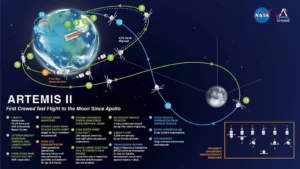
Fifty years after Apollo 17, four astronauts have traveled farther from Earth than any human beings in history. Here is the full story.
Introduction: A promise kept after 50 years
On April 2, 2026, humanity crossed a threshold that had been sealed shut for over five decades. NASA’s Artemis 2 mission launched from Kennedy Space Center, sending four astronauts farther from Earth than any human beings have ever traveled before. This was not just another space mission — it was the beginning of a new chapter in human space exploration, a sequel to a story left incomplete since December 14, 1972.
That was the last time a human being stood on the surface of the Moon. Astronaut Gene Cernan, commander of Apollo 17, climbed the ladder of his spacecraft and spoke words that have echoed through the decades:
“As we leave the Moon at Taurus-Littrow, we leave as we came, and, God willing, as we shall return, with peace and hope for all mankind.”
— Gene Cernan, Apollo 17, December 14, 1972
Nobody watching — not in Mission Control, not on television around the world — imagined that it would take more than 50 years to honor that promise. But NASA’s Artemis program is finally making good on it.
What is the Artemis program?
The Artemis program is NASA’s initiative to return humans to the Moon and establish a sustainable human presence there. Unlike the Apollo program — born out of Cold War rivalry between the United States and the Soviet Union — the Artemis program is driven by science, strategy, and a dramatically changed geopolitical landscape.
In the 1960s, NASA consumed nearly 4% of the U.S. federal budget. That level of funding was possible only because the Soviet Union had shocked America with Sputnik and Yuri Gagarin’s first spaceflight. Once Apollo 11 won the race, public interest faded and the program was wound down after Apollo 17.
The new space race is different. India’s Chandrayaan mission confirmed water ice at the Moon’s South Pole — transforming the Moon from a barren trophy into a potentially habitable resource. China has rapidly advanced its crewed spaceflight program with serious lunar ambitions. Private space companies have slashed launch costs. And international partnerships have replaced the old bipolar rivalry with a more complex, multilateral competition. Artemis is NASA’s response to all of this.
The heat shield crisis that almost stopped everything
Before discussing Artemis 2, it is essential to understand a significant technical crisis that tested NASA’s engineering resolve.
On November 16, 2022, Artemis 1 — an uncrewed test flight — completed its mission, but during atmospheric reentry, telemetry data and video footage revealed something alarming: the spacecraft’s heat shield was behaving unexpectedly. Post-flight inspection confirmed the worst: cracks had formed, and more than 100 pieces of charred material had broken away from at least four ablative layers.
NASA launched an extensive investigation. The cause was traced to trapped gases inside the heat shield that couldn’t vent properly during “skip reentry” — a technique where the spacecraft briefly exits the lower atmosphere before re-entering, causing a sharp spike in heating. This unexpected pressure buildup caused internal cracking and uneven char loss.
Redesigning and replacing the entire heat shield would have delayed Artemis 2 by a year or more. Instead, NASA made a smart decision: they modified the spacecraft’s reentry trajectory. By adjusting the angle and path of reentry, the most dangerous heating conditions are reduced in intensity, protecting the crew without requiring a complete redesign. The interior temperature during Artemis 1 had stayed within safe limits throughout — but with four human lives at stake, nothing could be left to chance.
The spacecraft: SLS rocket and Orion capsule
The Space Launch System
The orange-and-white Space Launch System is a heavy-lift launch vehicle designed to send humans and large payloads to deep space. Standing approximately 98 meters tall, the SLS generates 8.8 million pounds of thrust — more than the legendary Saturn V rocket that powered Apollo, despite being slightly shorter. Saturn V stood about 110 meters but produced only 7.6 million pounds of thrust. The SLS achieves this through a wider core stage and more efficient engine technology.
Artemis 2
The SLS consists of three main sections: a core stage housing four RS-25 engines (upgraded from the Space Shuttle program), two solid rocket boosters flanking the core (also Shuttle-derived), and an upper stage for cryogenic deep-space propulsion.
The Orion spacecraft
Artemis 2
Orion is where the four astronauts actually live during the mission. It consists of a conical crew module — the astronauts’ home for all 10 days — and a European Service Module built by the European Space Agency (ESA), which houses the main engine, fuel, water, oxygen, and nitrogen supplies.
Orion is designed for four astronauts (Apollo carried only three), with more advanced life support, significantly more powerful computers, and systems designed for long-duration deep-space missions. Its Environmental Control and Life Support System — activated with crew aboard for the first time during Artemis 2 — manages cabin pressure, oxygen, carbon dioxide removal, temperature, and humidity in real time.
The crew: four historic firsts
Reid Wiseman
Mission lead
Christina Koch
First woman at lunar distance
Victor Glover
First person of color in deep space
Jeremy Hansen
First non-American at lunar distance
The crew composition reflects a deliberate statement about who gets to explore space in the 21st century — and the international character of the Artemis program through the Artemis Accords framework.
The mission: day by day
Artemis 2
Why Artemis 2 matters: the bigger picture
Artemis 2 is not a Moon landing — that comes with Artemis 3. Its specific mission is to certify the Orion-SLS system with a human crew aboard, validate all life support and navigation systems in deep space, and establish the operational baseline for everything that follows.
But the implications reach far beyond a single flight. The Artemis program aims to establish permanent human infrastructure at the Moon — not plant a flag and leave, but build a sustainable presence. The Lunar Gateway station, planned for lunar orbit, will serve as a staging post. In-situ resource utilization of lunar water ice could provide oxygen and hydrogen for both life support and fuel. The South Pole — where the water is — will be the focus of future landing sites.
All of this is explicit preparation for Mars. The technologies, logistics, and human factors data gathered during Artemis missions are NASA’s roadmap to sending people to the Red Planet within the coming decades.
Artemis 2
Conclusion: a promise kept, a journey begun
Gene Cernan’s words from the Moon’s surface in 1972 promised a return. For 50 years, that promise was deferred by budget cuts, shifting priorities, and the absence of a compelling enough reason to go back.
The world has changed. The Moon has changed — from a dead trophy to a strategic resource with water ice at its poles. The competition has changed — China’s lunar ambitions have restored geopolitical urgency. The technology has changed — computers a thousand times more capable, materials that didn’t exist, private launch companies that have slashed costs.
And four people are now farther from home than any human beings have ever been, looking back at a blue marble floating in black silence, carrying all of us with them.
This is how the next chapter begins.
Artemis 2

How to Use ChatGPT in 2026 –The Complete Guide
Where is the Center of the Universe? Is the Origin of the Big Bang Right Above Your Head?