Ancient Architecture • Indian Heritage • History
Kailash Mandir at Ellora: The Temple Carved from a Single Mountain That Still Has Engineers Baffled
Joe Rogan called it “one of the most confusing places I’ve ever seen.” Here’s the full story — no aliens required.
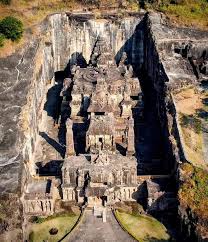
I want to start with a confession. When a friend first told me about the Kailash Mandir at Ellora, I thought he was exaggerating. “The whole temple came out of one rock?” I said. “Like, the whole thing?” He nodded. I didn’t believe him.
Then I went down the rabbit hole — and a few hours later I was still sitting there, jaw somewhere near the floor, trying to wrap my head around what 8th-century craftsmen actually pulled off in the hills of Maharashtra.
The Kailash Mandir isn’t just another ancient temple. It’s the world’s largest monolithic structure, carved from a single basalt cliff face about 1,200 years ago — using hammers and chisels. No crane. No dynamite. No concrete. Just extraordinary skill, patient labour, and an engineering logic that was, in its own quiet way, genius.
And yet, because it’s so astonishing, the conspiracy theories are everywhere. Aliens built it. Secret tunnels lead to other dimensions. It was carved by supernatural beings who could fly. So in this post, I want to do two things: give you the genuine jaw-dropping truth about this incredible place, and dismantle the myths that frankly do a disservice to the very real humans who built it.
What Is the Kailash Mandir, Exactly?
The Kailash Mandir — also written as Kailasa Temple — is Cave 16 in the Ellora Caves complex, located near Chhatrapati Sambhajinagar (formerly Aurangabad) in Maharashtra, about 350 km from Mumbai. It’s dedicated to Lord Shiva and named after Mount Kailash, his divine abode.
But calling it “Cave 16” is genuinely misleading. When you call something a cave, you imagine something underground, dark, and modest. The Kailash Mandir is none of those things. It’s a full-scale, multi-storey temple complex complete with a central shrine, gateway tower, mandapa (pillared hall), subsidiary shrines, elephant sculptures, and intricate narrative carvings — all cut downward from the top of a cliff.
Here are the headline numbers, and they do not get less impressive on repetition:
- 200,000 tonnes of basalt rock were excavated to create it — that’s roughly 40,000 adult elephants worth of stone
- The structure covers an area of approximately 81 metres long and 47 metres wide
- The main tower (shikhara) rises about 32 metres high
- The entire temple — every pillar, every elephant, every carved deity — is made from the same continuous rock
- No mortar, no joins, no separate stones assembled together — ever
A 1982 archaeological study confirmed this definitively: there is no break in the natural texture of the rock anywhere in the complex. What you’re looking at, from the elephants at the base to the very tip of the spire, is one single piece of stone.
Who Built the Kailash Mandir? The Historical Record
Unlike many ancient Indian monuments, we actually have reasonably strong historical evidence about who commissioned this temple — it just took some detective work to find it.
Historians point to King Krishna I of the Rashtrakuta dynasty as the patron. The Rashtrakutas were a powerful South Indian empire who, in the 8th century, defeated the Chalukyas and expanded northward into the Deccan region. Krishna I was known not just as a military commander but as a devoted follower of Lord Shiva and a genuine patron of the arts.
The key evidence comes from the Baroda copper plates — inscriptions made roughly 40 years after Krishna I’s reign. These plates, associated with a Rashtrakuta governor of Gujarat, contain two specific details: they name Krishna I by title, and they mention that this king built a remarkable Shiva temple at Ellora.
The inscription reportedly notes that even God and the architect who built the temple were left amazed by what they’d created. Which, honestly, feels very on-brand for this place.
The Origin Story — Myth Meets History
There’s also a lovely legend recorded in the 15th-century Marathi text Katha-Kalpataru (the Wish-Fulfilling Tree of Stories) that explains the top-down construction method in the most human way possible.
The story goes: a queen named Manikavati made a vow to Lord Shiva that if her ailing husband recovered, she’d build him a great temple — and she wouldn’t eat until she could see the temple’s shikhara (peak). When architects told the king it would take 16 months just to build the spire, a sculptor named Kokasa stepped forward and promised she’d see the shikhara in one week. His trick? Start from the top, not the bottom. The shikhara was built first, the queen broke her fast, and construction continued downward for years afterward.
It’s probably apocryphal. But the core engineering logic it describes — build top-down so the peak appears first — turns out to be exactly what actually happened. Sometimes old stories carry real information.
The Ellora Caves: Understanding the Kailash Mandir in Context
You can’t fully appreciate the Kailash Mandir without understanding that it sits within a 600-year tradition of extraordinary rock-cut architecture. The Ellora complex contains 34 caves total, built in three major phases:
| Cave Numbers | Period | Tradition | Notable Feature |
|---|---|---|---|
| 1–12 | 5th–8th century | Buddhist (Mahayana) | Viharas, multi-storey monasteries |
| 13–29 | 7th–10th century | Hindu | Shiva and Vishnu temples, narrative carvings |
| 30–34 | 9th–12th century | Jain | Delicate decorative carving, Indra Sabha complex |
The Kailash Mandir is Cave 16 — sitting in the Hindu section. But what sets it apart from all 33 other caves isn’t just its scale. It’s the sheer ambition of the project. The Rashtrakutas weren’t starting from scratch with an untested idea.
Before the Kailash Mandir, they’d already built Cave 11 (Do Thal — two storeys) and Cave 12 (Teen Thal — three storeys, with carved images of Gautam Buddha and figures resembling Lakshmi and Saraswati). They’d also completed Cave 15 (Dashavatara), a two-floor cave with 42 ornamental pillars surrounding a Shiva Lingam.
The Kailash Mandir wasn’t a wild experiment. It was the culmination of a tradition. And that matters when you’re trying to understand how it was built.
Beginner’s Guide: Planning Your Visit to the Kailash Mandir at Ellora
If you’re thinking of visiting, here’s what you need to know before you go:
- Location: Ellora Caves, Chhatrapati Sambhajinagar (Aurangabad), Maharashtra — about 30 km from the city centre.
- Best time to visit: October to March. The Maharashtra monsoon (June–September) can make the rock paths slippery, though the caves look dramatically atmospheric in the rain.
- Opening hours: Sunrise to sunset, daily except Tuesdays. The caves are illuminated in the early morning and late afternoon light — both are spectacular.
- Entry fee: Nominal fee for Indian nationals; higher rate for foreign visitors. Check the Archaeological Survey of India (ASI) website for current pricing.
- How to get there: MSRTC buses run frequently from Aurangabad. Hiring a cab or auto-rickshaw gives you flexibility to also visit the nearby Ajanta Caves on the same trip.
- Time needed: Budget at least 3–4 hours for the Ellora complex, with at least 90 minutes at the Kailash Mandir alone. Don’t rush it.
- Dress code: This is an active place of worship as well as a heritage site. Dress modestly and remove footwear when entering the sanctum.
- Hire a guide: Seriously — the carved narratives inside the temple (Ravana lifting Kailash, the Mahabharata panels, the Ramayana friezes) are incredible once someone explains what you’re looking at.
How Was the Kailash Mandir Actually Built? The Real Engineering
Here’s the part where I get properly excited, because the actual answer to this question is — in my opinion — more impressive than any alien theory.
The builders of the Kailash Mandir weren’t doing something unprecedented and mysterious. They were doing something extraordinarily difficult and disciplined, using knowledge accumulated over generations. Let’s walk through it.
Step 1 — Site Selection
The Rashtrakuta architects didn’t just pick any mountain. They sent teams to find a rock formation that was large enough, structurally uniform enough, and accessible enough to support what they had in mind. They found it in the Charanandri hills at Ellora — a massive basalt cliff face that could, in theory, yield an entire temple complex from a single carved-out block.
Step 2 — The Three Trenches
Once the site was chosen, excavation began — but not at random. According to the research of archaeologist M.K. Dhavalikar (whose paper you can find through the ASI archives), three large trenches were cut first: one at the back and one on each side of the rock mass that would become the temple.
The side trenches alone measured approximately 270 feet long, 50 feet wide, and 100 feet deep. That’s an extraordinary amount of excavation before the actual carving of the temple even began. This process removed roughly 200,000 tonnes of rock — and yes, we’ll get to where it went.
Step 3 — The Top-Down Carving Method
This is the one that confuses people most. Why on earth would you carve a temple from the top down? It sounds backwards. But it’s actually brilliant.
Think about it this way: once you’ve dug your trenches, you’ve got a block of rock standing in the middle. If you start carving from the bottom, you have nowhere to stand to reach the upper sections — and you’d have to build elaborate scaffolding in the pits around the temple.
By starting at the top and working downward, the workers always had a platform beneath their feet. The rock itself was the scaffolding. As each layer was completed, they descended to the next. The shikhara came first. Then the roof of the mandapa. Then the walls. Then the elephants at the base. Elegant, logical, genius.
Step 4 — The Hydraulic Expansion Technique
Now — basalt. If you’ve ever tried to chip at basalt, you know it doesn’t give easily. It registers 6 on the Mohs Hardness Scale — the same scale that puts diamond at 10 and talc at 1. We use basalt today in road construction because of how hard-wearing it is.
So how did 8th-century craftsmen cut through it with hand tools? The answer, archaeologists believe, involves a technique called hydraulic expansion:
- Workers would drill or chisel a line of small holes along the intended split line in the rock
- Dry wooden wedges were hammered into these holes
- The wedges were then soaked with water
- As wood absorbs water, it swells — and generates enormous internal pressure within the rock
- This pressure creates clean, predictable fractures along the intended line
- The resulting slabs could then be worked with chisels into finer shapes
It’s a technique with ancient roots across many cultures. And it explains how you could make precise, large-scale cuts in hard rock without access to industrial tools.
Step 5 — Where Did All That Rock Go?
Two hundred thousand tonnes of excavated basalt. That’s the mystery that feeds more conspiracy theories than almost anything else about this site. Where did it go?
The archaeological consensus — and it’s a sensible one — is that it didn’t “disappear” at all. It was reused. The Rashtrakutas were building extensively across their empire. Basalt is a superb construction material. The excavated rock was almost certainly used for buildings, roads, and local structures in the surrounding region — structures that have since crumbled, been demolished, or been incorporated into newer buildings over twelve centuries.
That’s not a dramatic explanation. But “they used the rubble for other construction projects” is exactly the kind of practical, efficient thing a competent empire running a multi-decade construction project would do.
The Alien Theory — And Why It Actually Insults the Real Builders
I want to spend a bit of time on this, because I think the alien theory — while superficially exciting — carries a frustrating undertone.
The theory gained traction partly through a 19th-century book, The Secret Doctrine by Helena Blavatsky, a Russian-American writer. In her second volume, she discussed temples like Ellora — but her language was entirely symbolic, referring to spiritual rather than literal underground chambers and “other worlds.” Modern conspiracy YouTubers took her symbolic text and translated it into literal claims about alien tunnels beneath the Kailash Mandir.
The irony is that the alien theory exists precisely because people underestimate what Indian craftsmen of the 8th century were capable of. The implicit logic goes: “This is so extraordinary that ordinary humans couldn’t have built it.” But that’s backwards. The Kailash Mandir is extraordinary because ordinary humans — highly skilled, disciplined, brilliant humans, but humans — built it over the course of a decade or more.
“The fact is that it’s not easy to point out who built the temple. But the most probable answer is that it was built by people who were well-versed in materials, physics, and practical engineering.” — Archaeological consensus on Ellora
The Chalukya and Rashtrakuta dynasties had been developing rock-cut architecture for generations. This wasn’t India’s first attempt at this kind of work — it was the pinnacle of a long tradition. Calling it alien construction doesn’t celebrate the mystery; it erases the achievement.
Pro Tips for Getting the Most Out of the Kailash Mandir
- Arrive at opening time. The morning light falls directly onto the southern face of the temple. The carved narrative panels — especially the Ravana lifting Kailash panel — are dramatically lit. By midday, the light becomes flat and harsh.
- Go to the upper gallery first. Many visitors don’t realise there’s a covered gallery running along the upper cliff edges on both sides of the courtyard. The view of the temple from up there gives you the best sense of its true scale.
- Look for the astronomical alignments. The temple’s main axis is oriented roughly east-west, designed so that the first light of dawn falls on the Shiva Lingam in the sanctum. This is deliberate and worth standing in the inner sanctum at dawn to experience.
- Don’t skip the subsidiary shrines. Most visitors spend all their time in the main temple area. The five small shrines around the courtyard have their own beautiful carvings — including some of the finest depictions of the Ashtadikpalas (eight directional guardians) in the country.
- Photograph the Ravana panel in the afternoon. The famous panel showing Ravana shaking Mount Kailash while Shiva pins him down with his toe is on the south side of the temple — it catches beautiful afternoon side-light.
- Use a local guide, not just an app. The iconographic programme of this temple is dense. A good guide will show you narrative sequences in the carvings that most visitors walk straight past.
What You’ll Actually See at the Kailash Mandir
Let me walk you through what visiting the temple actually looks like, because it’s not obvious from photos.
You approach through a gopura (gateway) that leads into a large courtyard. Ahead of you, rising from the floor of the courtyard, is the main temple — and this is where it hits you. The temple isn’t embedded in the cliff. It’s standing free in the middle of the excavated space, attached only at its base. The cliff walls form the sides of the courtyard, and the whole space feels like an outdoor cathedral.
The Key Structures Inside
- The Nandi Mandapa: A pavilion housing the bull Nandi, Shiva’s vehicle, facing the main shrine. Nandi is always positioned so he can see the Shiva Lingam — and here, carved from the same rock, his gaze is eternal.
- The Main Mandapa: The pillared hall leading to the inner sanctum. The ceiling here has remnants of painted murals — faded now, but evidence that the entire temple was once covered in colour.
- The Sanctum Sanctorum: Where the Shiva Lingam resides. Still an active place of worship. The atmosphere inside is genuinely extraordinary.
- The Narrative Panels: Running along the base and walls are extraordinary carved panels — Ravana shaking Kailash, scenes from the Ramayana, the cosmic battle between gods and demons. These aren’t decorative. They’re a theology in stone.
- The Elephants: Along the entire base of the temple platform, a frieze of elephants appears to “carry” the temple on their backs. Every elephant is carved from the same rock. None added separately.
The Kailash Mandir’s Place in Indian Architectural History
It’s worth stepping back and placing this temple in its broader historical context, because Ellora wasn’t operating in a vacuum.
The Kailash Mandir shows clear stylistic links to the Virupaksha Temple at Pattadakal in Karnataka, which was built by the Chalukyas — the dynasty the Rashtrakutas defeated. This connection isn’t coincidental. After conquering Chalukya territory, Krishna I brought Chalukya artisans northward, blending their architectural vocabulary with local traditions.
You can trace the family tree: Chalukya temples at Badami and Aihole → Chalukya temples at Pattadakal → Kailash Mandir at Ellora. Each generation pushed further. The Kailash Mandir is the result of that escalating ambition, built by craftsmen who’d spent their careers mastering the skills they’d need.
And the tradition continued after Ellora too. The Vettuvan Koil temple in Tamil Nadu — also 8th century, also carved from a single granite rock — shows that monolithic rock-cut temples were a regional tradition with many expressions. The Kailash Mandir is the grandest, but not the only one.
Common Mistakes Visitors Make at the Kailash Mandir
- Only visiting the Kailash Mandir and skipping the rest of Ellora. Cave 15 (Dashavatara) and Cave 32 (Indra Sabha, the Jain answer to Kailash) are both exceptional and often nearly empty of tourists. Don’t miss them.
- Coming in the midday heat. Maharashtra summers are brutal. Plan to arrive at 8–9am or return after 4pm. The golden-hour light is also dramatically better for photographs.
- Rushing through. An hour isn’t enough. The carvings reward close attention. Spend time looking at the panels at the base of the temple — most people walk past them entirely.
- Skipping the Ajanta Caves nearby. They’re 100 km away but absolutely worth combining into a two-day trip. The Buddhist painted caves at Ajanta are among the greatest art treasures anywhere on earth.
- Taking the alien tour content at face value. Some local guides lean into the more sensational narratives because tourists love them. The actual archaeology is every bit as fascinating — push for the real story.
- Not checking if the site is closed. The Ellora Caves are closed on Tuesdays. It sounds obvious, but you’d be surprised how many people show up on a Tuesday.
Why Conspiracy Theories Cling to This Place
I think it’s worth understanding — without dismissing — why the alien and supernatural theories around the Kailash Mandir persist. Because they’re not going away, and there’s a real psychological explanation for why they exist.
Conspiracy theories thrive in gaps. When there’s complete certainty — when we know exactly who built something, how, and why — there’s no gap for alternative theories to inhabit. The Kailash Mandir has genuine gaps: the copper plate evidence is indirect, the timeline is approximate, and the engineering remains awe-inspiring even when fully explained.
Add to this the “where did 200,000 tonnes of rock go?” question, and the alien theorists have their hook. Never mind that “they used it for other construction projects” is a perfectly adequate answer — it’s not a dramatic answer, and dramatic answers travel faster on YouTube.
The IISc (Indian Institute of Science) actually examined the ancient Vimana Shastra — the text on aeronautics that some claim connects to the temple’s design — in a 1974 study. Their conclusion was definitive: the described flying machines “simply could not fly based on real science.” The structural resemblance between the temple’s shikhara and a diagrammed Vimana is architectural convention, not evidence of alien technology.
The Kailash Mandir deserves better than aliens. What it actually represents — the accumulated knowledge of generations of craftsmen, the ambition of a king who wanted to build something worthy of a god, the decade-long labour of hundreds of skilled workers — is a genuinely moving story. And it’s all true.
Frequently Asked Questions About the Kailash Mandir
Yes, it is. The Kailash Mandir at Ellora is simultaneously a UNESCO World Heritage Site and a functioning Hindu temple. Devotees regularly worship at the Shiva Lingam in the inner sanctum. This dual status — living temple and protected monument — is one of the things that makes it so special. You’ll often find flowers, incense, and the sound of prayer alongside the archaeologists and tourists.
Archaeologists estimate the main construction phase took approximately 10 to 12 years, based on the scale of work and the likely workforce involved. Some scholars believe carving and refinement work continued for decades afterward under successors to Krishna I. There’s no definitive inscribed date for the project’s start or completion.
The temple is carved from basalt — a volcanic rock that ranks 6 on the Mohs Hardness Scale. This is not a soft or forgiving material. It’s the same rock used in modern road construction. The fact that craftsmen working with hand tools (chisels, hammers, and wooden wedges) cut such precise forms in basalt is a genuine engineering achievement. The hydraulic expansion technique — drilling holes, inserting wood, then soaking with water to split rock along controlled fracture lines — is the most widely accepted explanation for how large blocks were separated.
Yes — visitors can enter the courtyard, explore the mandapa (pillared hall), and in most cases enter the area around the inner sanctum. Access to the sanctum itself may be restricted depending on worship times and the temple’s operational status on a given day. The upper galleries along the cliff walls surrounding the courtyard are also accessible and offer the best overhead views of the temple complex.
No. The archaeological and historical evidence points clearly to construction by skilled human craftsmen under the patronage of King Krishna I of the Rashtrakuta dynasty in the 8th century CE. The “alien” theory emerged largely because the engineering achievements seem impossible — but the techniques (hydraulic expansion, top-down carving, systematic excavation) are well-documented in the archaeological literature. The conspiracy theories, while fun to read about, erase the very real achievement of generations of Indian craftsmen who built this extraordinary place.
They’re connected in name and in spiritual symbolism, but they’re completely different places. Kailash Parvat is the sacred mountain in Tibet believed to be the home of Lord Shiva — a natural mountain that no one has officially climbed. The Kailash Mandir at Ellora is a man-made temple named in honour of that mountain, designed to evoke its sacred character. The temple’s towering shikhara is intended as an earthly echo of the divine mountain. Read our full guide to Kailash Parvat here.
Closing Thoughts: What the Kailash Mandir Really Teaches Us
I’ve spent a lot of time with this story now, and here’s what keeps staying with me: the Kailash Mandir wasn’t built because anyone had to build it. No practical need demanded a temple of this scale, this complexity, this extraordinary difficulty.
It was built because someone — King Krishna I, his architects, his craftsmen — wanted to build something that would make even God stop and stare. And they succeeded. The copper plate inscription says as much: even the architect himself was amazed at what he’d created.
That’s a very human motivation. That desire to make something so beautiful, so ambitious, so beyond ordinary expectation that it outlasts you by a thousand years. The Kailash Mandir has now been standing for about 1,200 years. It’ll probably be standing for a thousand more.
If you’re planning to visit, here’s my honest advice:
- Go in the morning — the light and the relative quiet are both better
- Hire a knowledgeable guide — the carvings tell stories that repay understanding
- Spend time in the inner sanctum and let the scale of the place settle over you
- Combine it with Ajanta — two days, two UNESCO sites, one of the great cultural trips you can take anywhere in the world
- And skip the alien videos. The real story is better.
If you found this useful, explore our other guides to India’s rock-cut heritage sites — there’s a whole tradition of extraordinary architecture that most of the world hasn’t heard of yet. And if you’ve already visited the Kailash Mandir, I’d genuinely love to hear what struck you most about it.

Campa Cola Is Back — And This Time, It’s Playing to Win

Startups Indian Keep Running at a Loss — The Brutal Truth Nobody Tells You