Maratha History • Heritage • Valor
Chhatrapati Sambhaji Maharaj : The Fearless Lion Who Defied an Empire
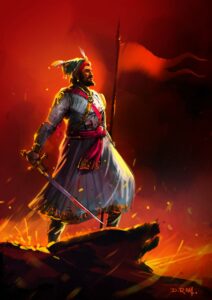
A warrior-poet, a philosopher-king, and a man who chose death over surrender. Here’s the story you probably weren’t told in school.
Let me ask you something. How many people do you know who, even while being tortured for forty days straight — eyes gouged out, nails ripped off, tongue cut — still refused to bow down?
I’ll wait.
Chhatrapati Sambhaji Maharaj was one such person. And yet, for much of mainstream history education, he gets a footnote. A brief mention sandwiched between his legendary father, Shivaji Maharaj, and the later Maratha empire. That’s not just incomplete — it’s almost criminal.
If you’ve watched the film Chhaava, you got a glimpse of this extraordinary man. But the real Sambhaji Maharaj? He’s so much more layered, so much more fascinating than any screenplay can capture.
So let’s fix that. Grab a chai, because this is going to be a proper deep-dive.
Who Was Chhatrapati Sambhaji Maharaj, Really?
Here’s the first thing you need to understand about Sambhaji Maharaj — he was born a prince. That might sound obvious, but it matters enormously. His father, Shivaji Maharaj, wasn’t born into royalty. Shivaji built everything from scratch. But Sambhaji came into a world that already had an empire in motion, with all the intrigue, jealousy, and political backstabbing that comes with it.
And yes, that shaped him. He was intense, fiery, and yes — unapologetically aggressive. But before you call that a flaw, think about what his life looked like from day one.
- His mother died when he was just two years old.
- He was sent to Aurangzeb’s court as a “political guest” — essentially a hostage — when he was barely a child.
- He watched his father navigate impossible political waters and famously escape from Agra Fort.
- When Shivaji Maharaj passed away, Sambhaji wasn’t even properly informed. Court politics kept him in the dark while conspiracies swirled around the succession.
So when historians say he was “hot-headed” or had “too many flaws,” it’s worth asking — wouldn’t you be a little intense too?
The Scholar Nobody Talks About
Here’s something that genuinely surprised me when I learned it — Sambhaji Maharaj wrote the Budhbhushan (also spelled Budhabhushana) at just fourteen years of age. This isn’t a teenager’s diary. It’s a serious political treatise, drawing heavily from Chanakya’s Arthashastra, covering statecraft, governance, and social structure.
If you put the two texts side by side, scholars find remarkable similarities. The man was a philosopher before he was a king. A poet. An intellectual. The sword-wielding fearless warrior and the literary scholar? Same person. One and the same.
Did You Know?
Sambhaji Maharaj wrote in Sanskrit and was proficient in multiple languages. His literary works, including Budhbhushan and Nayikabhed, reveal a man of extraordinary intellectual depth — a side of him rarely discussed in popular history.
Ascending the Throne: A Kingdom on Fire
Becoming a king sounds glorious. But what Sambhaji Maharaj walked into at twenty-four was, honestly, a mess. And not just from outside threats.
His own ministers and courtiers were conspiring against him. Factions within the Maratha court wanted to put his younger half-brother Rajaram on the throne instead. There were whispers, plots, betrayals — and he had to deal with all of this while Aurangzeb was literally marching south with the largest Mughal army ever assembled.
Let that sink in. Aurangzeb had already dismantled the Adilshahi and Qutubshahi sultanates, two major powers of the Deccan. He came south with a singular mission: finish what wasn’t done. Crush the Marathas once and for all.
And the man standing between Aurangzeb and that goal? A twenty-four-year-old king managing a civil war inside his own court, external threats on every front, and a legacy that would inevitably be compared to one of history’s greatest warriors.
No pressure, right?
| Aspect | Shivaji Maharaj | Sambhaji Maharaj |
|---|---|---|
| Background | Born to a Jagirdar, built empire from nothing | Born a prince, inherited ongoing empire |
| Challenges | Building legitimacy, guerrilla warfare | Internal conspiracies, Mughal onslaught, multiple fronts |
| Literary Works | Primarily strategic and administrative edicts | Sanskrit treatises including Budhbhushan, Nayikabhed |
| Military Record | Founded and expanded the Maratha empire | Never lost a battle in 9 years of reign |
| Death | Natural causes, 1680 | Captured, tortured for 40 days, executed 1689 |
The Military Genius: War on Every Front
Here’s a claim you’ll hear: Sambhaji Maharaj remained undefeated in all his military engagements during his nine-year reign. Some call it exaggerated. But look at the evidence.
He wasn’t just defending his father’s territory. He was actively fighting — and winning — simultaneously on multiple fronts:
Taking on the Portuguese in Goa
When the Portuguese at Goa started backing the Siddis and corresponding with Aurangzeb against the Marathas, Sambhaji Maharaj didn’t wait. He personally led a charge — arriving at the battlefield with just 600 men, riding in with both swords drawn, flanked 301 soldiers on each side.
A Portuguese letter from that period reportedly stated: “The Maratha Chhatrapati came at us in such a manner that none of us dared aim a gun at him, knowing that if a single bullet touched him, the Marathas would tear us apart.” He rode straight into their lines and drove them back decisively.
Later, when he pushed into Portuguese territory near a fortified church island, the battle was so one-sided that the Portuguese themselves wrote: “We have never been beaten so badly by anyone in all of India — not even by the English.”
The Epic Defense of Ramshej Fort
Aurangzeb sent a general named Shahbash to take Ramshej Fort, near Nashik. This fort had roughly 400 defenders. What followed was one of the most remarkable sieges in Indian history — the fort held for seven full years.
When the Mughals built elevated wooden platforms to mount their cannons above the fort walls, the Marathas sneaked down at night, raided the Mughal gunpowder stores, brought it back up, and started shooting back — with leather-and-wood cannons they’d fashioned themselves from goatskins. You read that right. Goatskin cannons.
Even a Mughal sorcerer was sent up with a golden snake, supposedly to break Maratha morale. He was knocked back down with a slingshot stone.
Ramshej eventually fell — not because the Mughals won militarily, but because someone on the inside was bribed. Betrayal, not defeat.
[ Image: Ramshej Fort, Nashik, Maharashtra ]
Alt text: Ramshej Fort near Nashik where Maratha soldiers held out for seven years against Mughal forces
Sheltering Akbar: A Bold Political Move
Then there’s the story of Akbar — Aurangzeb’s own son, who rebelled against his father and needed refuge. Durga Das Rathore, the legendary Rajput warrior, brought Akbar south after a daring escape through Rajputana. And Sambhaji Maharaj gave him sanctuary.
This was a direct, open provocation to Aurangzeb. No ambiguity. “You want your rebellious son? He’s with me.” It accelerated Aurangzeb’s march south — but it also showed something about Sambhaji’s character: he wasn’t just a reactive defender. He played the long game politically too, trying to create coalitions and alliances that would weaken Aurangzeb from within.
The Forty Days That Defined History
This is the part of the story that stays with you.
In early 1689, Sambhaji Maharaj was in the Konkan region, staying at a place called Sangameshwar. Accounts differ on the exact details of how it happened, but the consensus is painful: someone from within his own circle tipped off the Mughals about his location.
He was captured.
And Kavi Kalash — knowing full well that death awaited — composed a verse on the spot: “Haan Raje, tum ho saaje, khoob lade tum jang — dekh tumhara tej, takht taj Aurang.” (“Yes, O King, you are magnificent, you fought brilliantly — seeing your glory, Aurangzeb himself descended from his throne.”)
— As recounted in historical accounts of the Sambhaji Maharaj capture, 1689
Aurangzeb reportedly demanded three things: reveal the treasury, name the traitors in the Maratha court, and convert to Islam.
Sambhaji Maharaj refused. Every single time.
What followed was forty days of systematic, escalating torture:
- His tongue was cut out (after he reportedly mocked Aurangzeb’s appearance in court).
- His eyes were gouged out.
- Nails were pulled out.
- Bones were broken.
- Skin was flayed.
- Salt was rubbed into wounds.
Even through all of this, the accounts say he never gave up any information. Never surrendered. Never converted.
On March 11, 1689, he was beheaded. His body was dismembered and thrown in different directions — a deliberate message that there was no dignified burial for those who defied the empire.
But here’s what Aurangzeb didn’t count on. The Marathas didn’t break. They exploded.
The Aftermath: How His Death Sparked a Revolution
Aurangzeb genuinely believed that killing Sambhaji Maharaj meant he’d won. He’d decapitated the Maratha leadership. Surely the rest would fall in line.
He miscalculated spectacularly.
The Marathas’ response to Sambhaji’s death transformed into one of the most intense guerrilla campaigns in Indian history. Santaji Ghorpade and Dhanaji Jadhav — two of the most ferocious Maratha generals — began hunting Mughal forces with relentless aggression. They’d appear, destroy, and vanish before a counterattack could be organized.
The Marathas developed a brilliant tactical approach: fight every fort for as long as possible, exhaust Mughal resources, then surrender in May — right before the monsoon made travel through the Sahyadris and Konkan impossible. Come July, when Aurangzeb’s troops couldn’t move, the Marathas would take it all back. Two months later, the cycle repeated.
An Iranian Shah reportedly sent a messenger to Aurangzeb, mocking him: “You call yourself Alamgir — conqueror of the world. You couldn’t keep Shivaji prisoner in Agra, you couldn’t defeat him in battle, and now you’ve been trapped in the south for years by his son’s ghost. You’re not a world-conqueror. You’re just someone who imprisoned his own father.”
Aurangzeb died in 1707, in Ahmednagar, still fighting. Still unfinished. The Maratha empire, far from being crushed, was on the verge of its greatest expansion under the Peshwas.
[ Image: Raigad Fort, the seat of the Maratha Empire ]
Alt text: Raigad Fort in Maharashtra, the capital of the Maratha Empire under Shivaji and Sambhaji Maharaj
Beginner’s Guide: Key Terms & Context
New to Maratha history? Here are some quick explainers to help you follow along:
- Chhatrapati: A sovereign title meaning “Lord of the Umbrella” — essentially Emperor. Both Shivaji and Sambhaji held this title.
- Swarajya: The Maratha concept of self-rule. Not just political independence, but a cultural and spiritual identity.
- Siddis: African-origin naval commanders, mostly based around Janjira, who allied with the Mughals against the Marathas.
- Peshwa: Prime Minister of the Maratha Empire. After Sambhaji’s era, the Peshwas (particularly the Bhatt family) became enormously powerful.
- Chauth: A tax levied by the Marathas — one-fourth of the revenue of territories they protected or controlled. A key source of imperial revenue.
- Janjira Fort: A sea fort off the coast of Maharashtra that the Marathas never managed to capture — a famous “unfinished” chapter of Maratha history.
Why Sambhaji Maharaj Deserves More Credit
Here’s an honest question: why is Sambhaji Maharaj so often portrayed as “the impulsive one” or “the flawed king” when compared to Shivaji Maharaj?
Part of it is the natural comparison trap — Shivaji Maharaj is a titan of history. Anyone standing next to that legacy looks smaller by default. But consider what Sambhaji actually did:
- Maintained the Maratha empire against the most powerful military force in the subcontinent for nine years.
- Fought on at least five different fronts simultaneously — Mughals, Portuguese, Siddis, internal conspirators, and frontier kingdoms.
- Sheltered political refugees and built diplomatic alliances even while under siege.
- Never surrendered in battle, and never compromised his faith even at the cost of his life.
- His refusal to yield arguably galvanized the Maratha resistance more than any victory could have.
Some historians argue his so-called “flaws” — the intensity, the decisiveness, the unwillingness to back down — were the same qualities that let him endure forty days of torture without breaking. You can’t have it both ways. The fire that made him difficult in peacetime was the fire that made him unbreakable in extremis.
Pro Tips: How to Explore Sambhaji Maharaj’s History More Deeply
- Read primary sources: Portuguese letters and Mughal court documents from Aurangzeb’s Deccan campaigns contain fascinating first-hand accounts of Sambhaji’s military campaigns — often more honest than later retellings.
- Explore regional historians: Marathi historians like Vishwas Patil and Ranjit Desai have written extensively and accessibly on this period. Don’t rely only on textbook summaries.
- Visit the forts: Raigad, Panhala, Ramshej, Pratapgad — these aren’t just tourist spots. Walking these spaces gives you a visceral sense of the geography and strategy involved in Maratha warfare.
- Cross-reference the narrative: Multiple perspectives reveal different facets. Mughal accounts, Portuguese records, and Maratha chronicles often describe the same events very differently — all of them are instructive.
- Understand the Chhaava context: The 2025 film dramatized many events for cinematic effect. Use it as an entry point, not a textbook. Then dig deeper.
Common Mistakes People Make When Discussing Sambhaji Maharaj
- Reducing him to just “Shivaji’s son”: He was a leader, scholar, and warrior in his own right, not merely a footnote to his father’s legacy.
- Treating “fiery temperament” as simple vice: Without understanding the traumatic political environment he navigated from childhood, calling him merely “hot-headed” is reductive and unfair.
- Accepting the “120 undefeated battles” claim uncritically: While his military record was extraordinary, historians debate the exact numbers. The spirit of the claim — that he was militarily undefeated — is substantively supported, even if the specific count is disputed.
- Ignoring his literary contributions: Budhbhushan alone deserves serious academic attention as a political treatise. His scholarly side is almost always overlooked in popular accounts.
- Assuming his death was a Mughal victory: In hindsight, his death proved to be one of the most catastrophic miscalculations Aurangzeb ever made. It unified and enraged the Marathas in ways that his capture never could.
Frequently Asked Questions About Chhatrapati Sambhaji Maharaj
The Man Who Chose Legacy Over Life
Here’s what I keep coming back to when I think about Chhatrapati Sambhaji Maharaj. He was given choices. Aurangzeb wanted things from him — information, conversion, submission. Any one of these, and the torture stops. He survives. Maybe he even gets comfortable captivity.
He chose none of them.
For forty days.
We live in a world where we celebrate resilience in motivational quotes and Instagram posts. But Sambhaji Maharaj’s story is what actual, no-metaphor-required resilience looks like. It’s not comfortable. It’s not quotable. It’s brutal and tragic and ultimately triumphant in the most unconventional way.
Because his death didn’t end the Maratha cause. It became the cause. The spark that turned a kingdom into an empire.
If you want to explore more:
- Read Chhaava by Shivaji Sawant — the original Marathi novel the film is based on. It’s extraordinary.
- Visit Raigad Fort and Tulapur (where he was executed) if you’re in Maharashtra.
- Explore our article on the Maratha Empire’s rise under Peshwa Baji Rao I →
- Read about Santaji Ghorpade and Dhanaji Jadhav — the men who avenged him →
- Cross-reference Mughal court documents and Portuguese letters for a remarkable outside perspective on Maratha military power.
History has a way of remembering the people who never bent. Sambhaji Maharaj is one of those people. It’s about time more of us knew his full story.
Startups Indian Keep Running at a Loss — The Brutal Truth Nobody Tells You

Campa Cola Is Back — And This Time, It’s Playing to Win

India’s Last Real IMAX : Why Every Film Lover Must Visit Gujarat Science City