Indian History · Culture · Heritage
Chhatrapati Shivaji Maharaj: The Real History Most Textbooks Won’t Tell You
Let me be honest with you right at the start — most of us learned an incomplete version of Indian history. We got dates, battles, and dynasty names, but we rarely got the soul of it. And nowhere is that gap more painful than when it comes to Chhatrapati Shivaji Maharaj.
I remember sitting in a history class in school, textbook open, staring at a two-paragraph summary of one of the most remarkable rulers this subcontinent has ever produced. Two paragraphs. For a king whose strategic genius, administrative brilliance, and moral character built an entire empire from scratch — as a teenager, against all odds.
That always bothered me. And if you’re reading this, chances are it bothers you too.
So let’s do this differently. Let’s actually talk about Chhatrapati Shivaji Maharaj — not as a footnote or a regional figure, but as the towering historical personality he truly was. No spin, no agenda. Just honest history.
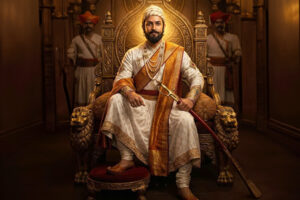
Who Was Chhatrapati Shivaji Maharaj, Really?
Born in 1630 CE at Shivneri Fort in what is now Maharashtra, Shivaji Bhonsle grew up in a time when the Deccan was fragmented among competing powers — the Adilshahi Sultanate of Bijapur, the Nizamshahi of Ahmadnagar, and the ever-expanding Mughal Empire under Aurangzeb slowly tightening its grip southward.
His mother, Jijabai, was not just a caretaker. She was a teacher, a strategist’s first mentor, a woman who deliberately shaped a child into a king. She read him the Ramayana and Mahabharata — not as bedtime stories, but as case studies in dharma, courage, and leadership. His father Shahaji Raja gave him the concept of Swarajya — the idea that their people deserved a kingdom of their own.
By the time Shivaji was in his mid-teens, he had already started assembling the group of loyal companions — the Mavals — who would go on to form the backbone of the Maratha empire. Not through wealth or coercion, but through sheer personal inspiration.
“He didn’t just build forts — he built a people’s belief that they could govern themselves.”
— A sentiment echoed by historians of the Maratha period
That’s the part that gets lost. Chhatrapati Shivaji Maharaj wasn’t just a warrior. He was a system-builder. He created a navy when everyone else was fighting on land. He designed the Ashtapradhan Mandal — an eight-minister council that distributed governance responsibilities — centuries before modern democracies got comfortable with the idea of checks and balances.
Was Chhatrapati Shivaji Maharaj Secular? Let’s Actually Settle This
This is the question that triggers more arguments online than almost anything else in Indian historical discourse. So let’s handle it carefully and honestly.
The short answer: It’s the wrong question, and here’s why.
The word “secular” as we use it today is a 20th-century constitutional concept. Asking whether a 17th-century king was “secular” is like asking whether a medieval physician practiced evidence-based medicine — the framework didn’t exist yet.
What we can accurately say is this: Shivaji Maharaj had a clear Hindu identity and was deeply committed to Dharma. His Ashtapradhan Mandal included a position called Dharmanyay Pandit — essentially a chief justice whose rulings were grounded in dharmic principles. In 17th-century India, religion was the constitution. The law was the Dharmashastra. If you had a judge, they were interpreting religious principles.
Does that mean he was hostile to other faiths? The historical record says no — but with important nuance.
- He had Muslim soldiers and commanders in his army — names like Siddi Ibrahim and Daulat Khan are documented.
- He reportedly treated mosques under his control with general respect.
- At the same time, when temples that had been demolished by the Adilshahi were under his control, he restored them. He converted mosques in Kalyan and Bhivandi — which had originally been temples — back to their prior use or repurposed them as granaries.
- When his general Netoji Palkar was forcibly converted to Islam by Aurangzeb, Shivaji Maharaj welcomed him back and facilitated his return to Hinduism. That’s not a “secular-blind-to-religion” act. That’s someone with deep religious conviction acting on it.
The more useful term, as many historians have noted, might be Dharmnirpeksh in the classical sense — someone guided by universal dharmic principles — rather than the modern political concept of secularism.
He wasn’t anti-Muslim. He was pro-his-people. And his people’s civilization, culture, and faith had been under sustained assault. His resistance was as much civilizational as it was political.
The concept of “Swarajya” that Shivaji Maharaj championed wasn’t about ethnic or religious exclusivity — it was about the right to self-governance. Every group within his kingdom had a role. His navy, for instance, included sailors from Koli and other communities. His military genius was in integration, not segregation.
Shivaji Maharaj vs. the Mughals: Why This Comparison Matters
Here’s an argument you’ll run into on the internet: “What’s the real difference between the Mughals and the Marathas? They were both just empires trying to expand.”
On the surface, it sounds like a neutral, both-sides perspective. But it collapses under the slightest historical scrutiny.
Think about it this way. If you’re living peacefully in your home and someone shows up, tells you your home is theirs, demands you change your name to match theirs, and tears down the temple in your courtyard — and you fight back — are you the same as the person who attacked you?
That’s the Aurangzeb-vs-Shivaji dynamic in plain terms.
| Factor | Chhatrapati Shivaji Maharaj | Aurangzeb (Mughal) |
|---|---|---|
| Origin | Native to the Deccan, defending his homeland | Delhi-based, expanding southward |
| Temple Policy | Restored and protected temples; no documented looting of Hindu temples | Documented demolition of Kashi Vishwanath, Mathura temple; imposition of Jizya |
| Religious Policy | Welcomed all communities; enforced dharmic law | Re-imposed Jizya tax on non-Muslims; widespread forced conversions documented |
| Governance Model | Ashtapradhan Mandal — distributed, council-based | Centralized autocracy; later years marked by paranoia and executions of family |
| Vision | Swarajya — self-governance for the people | Expansion of Islamic empire across the subcontinent |
| Treatment of Conquered Regions | Often returned governance to local rulers (e.g., Mallamma Devi of Karnataka) | Imposed heavy taxation, religious restrictions on conquered peoples |
The comparison isn’t about demonizing an entire community. Most historians — including those critical of the Mughal policy of that era — are careful to distinguish between the actions of rulers and the people of any given faith. Today’s Muslims didn’t impose Jizya on anyone. But pretending the historical record doesn’t say what it says isn’t neutrality — it’s dishonesty.
Why Isn’t Chhatrapati Shivaji Maharaj’s History Taught Properly?
This is the question that frustrates people most — and honestly, it frustrated me too for a long time.
Students who grew up in Maharashtra know Shivaji Maharaj’s story in depth. The forts, the campaigns, the administrative innovations, the moral philosophy — it’s woven into Marathi culture. But step outside Maharashtra, and students often know only a vague outline, if that.
There are a few overlapping reasons for this:
1. The “Delhi is the Center” Bias
A significant chunk of Indian history education — especially NCERT frameworks for many decades — was organized around the Delhi Sultanate and Mughal Empire as the “main story.” Rulers who resisted from outside Delhi were treated as regional figures, not national ones.
But here’s the thing: Shivaji Maharaj’s concept of Swarajya directly inspired the 1857 uprising. The Rani of Jhansi invoked it. Bal Gangadhar Tilak built the annual Shivaji Jayanti celebration specifically to create a unifying national symbol around it. The freedom movement itself drew deeply from this well.
2. Ideological Framing
Any honest discussion of the Mughal period requires grappling with religious persecution, temple destruction, and forced conversions. Certain strands of academic historiography — for genuinely complex reasons that go back to Cold War-era intellectual politics — were uncomfortable making strong moral judgments about this. The result was a kind of flattening: Shivaji Maharaj got “regionalized,” and Aurangzeb’s violence got contextualized into near-invisibility.
3. Contemporary Bakhars and Primary Sources Are Underused
The Sabhasad Bakhar, the Chitnis Bakhar, the contemporary accounts of Shivaji Maharaj’s era — these are rich, detailed sources. But history education in India has often relied on secondary synthesis rather than primary accounts. When you go to the primary sources, a much richer, more textured picture of Chhatrapati Shivaji Maharaj emerges.
Some people on both sides of the debate about Shivaji Maharaj make the error of either hagiography (treating him as flawless and godlike) or cynical debunking (looking for any flaw to dismiss his significance). Neither serves genuine understanding. He was a remarkable human being — strategically brilliant, deeply principled by his own worldview, capable of both great mercy and hard military decisions. History doesn’t require saints or villains. It requires honesty.
A Storytelling Moment: The Poet Bhushan and the King
I want to share a story that I think captures something essential about Chhatrapati Shivaji Maharaj — something that no table of battles and dates can convey.
Bhushan was a celebrated poet at Aurangzeb’s court. Talented, well-paid, performing his role in the Mughal cultural machine. But the stories reaching him from the south — of a king who fought not for personal glory but for his people, who didn’t name forts after himself, who didn’t want an oversized throne — those stories kept pulling at him.
Eventually, Bhushan left. He traveled to Raigad, where Shivaji Maharaj held court. Not knowing who he was speaking to, Bhushan sat near a temple and recited a poem he had composed:
Kashi ki kala jaati, Mathura Maseed hoti, Agar Shivaji na hote, toh sunnat hoti sab ki.
— Attributed to Bhushan, court poet (later of the Maratha court)
The man listening asked him to recite it again. And again. Twelve or thirteen times. Finally Bhushan asked, exasperated: “Why do you keep asking?” The man replied: “Because every time you sing it, I make gold coins in your name. I am the one you are singing about.”
It’s a story about recognition — but not the kind kings usually seek. Shivaji Maharaj wasn’t craving praise. He was moved by the truth of it. That a poet from the enemy’s court saw clearly what was at stake. That someone on the other side recognized what the resistance meant.
That says something profound about the man.
Beginner’s Guide: Understanding Chhatrapati Shivaji Maharaj’s Legacy
If you’re just starting to explore this history, here’s a simple roadmap to build your understanding:
Step 1: Start with the Bakhars
The Sabhasad Bakhar is a contemporary account written by one of Shivaji Maharaj’s court officials. It’s the closest thing to a primary source you’ll find. English translations exist — look for scholarly editions rather than popular retellings.
Step 2: Understand the Geopolitical Context
Read about the Adilshahi Sultanate, the Nizamshahi, and the Mughal expansion into the Deccan. Without understanding the pressure Shivaji Maharaj was operating under — multiple hostile powers, no standing army at the start, no treasury — his achievements become even more striking.
Step 3: Study the Ashtapradhan Mandal
This eight-minister council is genuinely ahead of its time. Each minister had a defined portfolio: finance, justice, foreign affairs, military, etc. It prevented autocratic concentration of power and created institutional continuity. Understanding this will reshape how you think about “traditional” governance systems.
Step 4: Learn About His Naval Strategy
Shivaji Maharaj built India’s first significant naval fleet — the Maratha Navy. He understood that controlling the western coastline was essential for trade, defense, and projecting power. The British, Portuguese, and Siddis all had naval superiority — and he built from scratch to challenge them.
Step 5: Read About His Philosophy of Swarajya
This is perhaps the most enduring part of his legacy. Swarajya doesn’t just mean “self-rule” in a political sense — it means the right of people to govern themselves according to their own values, to live without fear, to protect their culture and their families. It was a living philosophy, not just a political slogan.
- Visit the forts. Raigad, Pratapgad, Sinhagad — these aren’t just tourist spots. Walking them gives you a physical understanding of the military geography that shaped every decision Shivaji Maharaj made.
- Look for multilingual sources. Marathi bakhars give you one angle; Persian-language Mughal documents give you another. The truth sits between them.
- Be skeptical of both excessive praise and dismissive criticism. If a source makes Shivaji Maharaj sound like a divine figure with no complexity, be cautious. If a source is obsessively hunting for reasons to diminish him, be equally cautious.
- Cross-reference with contemporary foreign accounts. Dutch, Portuguese, and English East India Company records from the 17th century contain references to Shivaji Maharaj — often with admiration that surprises modern readers.
- Explore Tilak’s Shivaji Jayanti speeches. Bal Gangadhar Tilak’s revival of the Shivaji festival was a political masterstroke — understanding why he chose this figure as the symbol of national revival is itself a fascinating piece of history.
Is Chhatrapati Shivaji Maharaj Relevant Today?
This might seem like the easiest question, but it’s actually the most important one.
The obvious answer is: yes, because history is always relevant. But that’s a bit of a cop-out. Let me give you something more concrete.
The concept of Swarajya — which Chhatrapati Shivaji Maharaj didn’t just preach but actually lived — is deeply relevant to democratic citizenship in 2026. Swarajya meant that a woman walking through her village shouldn’t live in fear. That the artisan and the farmer had rights that existed independent of the king’s mood. That governance isn’t a favor the powerful give to the weak — it’s a responsibility.
In India’s current political climate, where caste, language, and regional identity are weaponized regularly, Shivaji Maharaj’s model of inclusive governance — drawing talent from every community, focusing on the welfare of the governed, not personal aggrandizement — is a genuinely useful counter-model.
Notice that he never named a single fort after himself. He reportedly resisted getting his own coronation done for years because he felt it was premature. When he finally did undergo the Rajyabhishek, he insisted on a throne large enough for all his companions to sit beside him.
That kind of ego-less leadership isn’t just historically interesting. It’s a model we desperately lack today.
- Childhood: The importance of foundational values — Jijabai’s role shows that parents shape kings before kingdoms do.
- Youth (16–24): Choose your companions with extraordinary care. Shivaji’s Mavalas were his most important resource.
- Working years: Duty before comfort. He led a campaign against Afzal Khan just two months after losing his wife Sai Bai. Grief didn’t eliminate responsibility.
- Leadership: Collective consciousness over personal glory. His dream was always “our dream,” never “my dream.”
- Legacy: Build institutions, not monuments. The Ashtapradhan Mandal outlasted him; his personal glory wouldn’t have.
Common Mistakes People Make When Discussing Shivaji Maharaj’s History
Whether you’re a student, a curious reader, or someone who gets into history debates online, here are the most common errors to avoid:
- Calling him just a “regional figure.” The freedom movement explicitly drew on his legacy. That’s not regional — that’s national.
- Conflating Shivaji Maharaj’s successors’ actions with his own. The later Peshwa period had its own complexities, including significant caste-based discrimination. That’s a separate chapter, not a reflection on Shivaji Maharaj’s own governance.
- Treating the secular-vs-Hindu debate as binary. He was a committed Hindu king who ruled over a diverse population. Both things are true simultaneously.
- Using him as a political cudgel without reading his actual history. Tragically, some of the people who invoke his name most loudly haven’t read a single bakhar or serious historical account of his reign. Don’t be that person.
- Dismissing criticism as blasphemy, or accepting every criticism as automatically valid. He was a historical figure, not a god. He can withstand honest examination — and that examination, done rigorously, only deepens the appreciation.
Frequently Asked Questions About Chhatrapati Shivaji Maharaj
Chhatrapati Shivaji Maharaj was born on February 19, 1630 CE (some historians cite 1627) at Shivneri Fort in the Pune district of present-day Maharashtra. His mother was Jijabai and his father was Shahaji Bhonsle, a Maratha military commander who served the Adilshahi Sultanate.
The Ashtapradhan Mandal was an eight-minister council established by Chhatrapati Shivaji Maharaj to govern his kingdom. Each minister had a specific portfolio: the Peshwa (Prime Minister), Amatya (Finance), Sachiv (Correspondence/Records), Mantri (Intelligence), Senapati (Military Commander), Sumant (Foreign Affairs), Nyayadhish (Chief Justice), and Panditrao (Religious/Charity Affairs). It was a remarkably sophisticated distributed governance model for the 17th century.
Yes — this is one of his most underappreciated achievements. Recognizing that the western coast was vulnerable to Portuguese, British, and Siddi naval power, Chhatrapati Shivaji Maharaj built a substantial fleet of warships and established naval bases like Vijaydurg and Sindhudurg. His naval strategy was so effective that some historians credit it as the first systematic Indian naval force. The Maratha Navy under his command was a genuine regional power.
Historical accounts consistently note that Shivaji Maharaj maintained strict codes regarding the treatment of women — including women from enemy families — in his military campaigns. There are multiple documented instances of him returning captive women to their families with honor. His code of conduct for his army explicitly prohibited mistreatment of non-combatants, particularly women. For a 17th-century military leader, this was notably progressive.
Swarajya — literally “self-rule” — was the foundational political philosophy that Chhatrapati Shivaji Maharaj inherited from his father Shahaji Raja and expanded into a lived reality. It meant that the people of the Deccan deserved a kingdom of their own, governed by their own laws, protecting their own culture. The concept was explicitly invoked during the 1857 uprising, by Lokmanya Tilak in the national movement, and continues to be relevant as a framework for thinking about democratic self-determination and cultural sovereignty.
The controversy has multiple dimensions. Maharashtra’s state curriculum gives Shivaji Maharaj extensive coverage — because he is, rightly, central to Marathi history and culture. National NCERT curricula historically gave him less prominence than Mughal rulers, which many critics argue reflects a Delhi-centric bias in how Indian history has been framed. There are also ongoing debates about which historical claims are supported by primary sources (the bakhars and contemporary documents) versus which are later mythologization or politically motivated reinterpretation.
Some starting points: “Shivaji: The Grand Rebel” by Dennis Kincaid (an older British account, interesting for its external perspective), the translated Sabhasad Bakhar for a primary source flavor, and academic works by historians like Jadunath Sarkar. For accessible modern accounts, look for books by scholars rooted in Marathi historiography who work from the original bakhar sources. Always check the bibliography — sources that cite primary documents are more reliable than those that only cite other secondary sources.
Conclusion: The History We Owe Ourselves
Here’s what I keep coming back to: the story of Chhatrapati Shivaji Maharaj isn’t really a political controversy. It’s a history lesson that we — all of us, across every community in India — were partially denied.
It’s the story of a boy raised on dharmic values by a remarkable mother, who turned those values into a functioning kingdom against overwhelming odds. It’s the story of a leader who thought about institutions, not just victories. Who built a navy when everyone else was thinking land. Who treated his enemies’ women with more honor than most of his contemporaries treated their own subjects.
Whether you’re Hindu or Muslim, Marathi or Tamil or Bengali or Punjabi — the story of Chhatrapati Shivaji Maharaj is your history too. Because the idea of Swarajya — that people deserve to govern themselves, to live without fear, to protect their culture — belongs to everyone.
Don’t wait for a textbook revision to give it to you. Go find it yourself.
- Read one primary source account — even a translated excerpt of the Sabhasad Bakhar — before you read any modern retelling.
- Visit at least one Maratha-era fort if you’re in Maharashtra. Raigad is the most significant. The physical landscape will reshape your mental picture immediately.
- Have one conversation about this history with someone who disagrees with you — and approach it with curiosity, not combat.
- Teach a child in your life one true, specific story from Shivaji Maharaj’s life — not a vague “he was a great king,” but a real incident with real stakes.
- Question every secondary source. Ask: what is this based on? What bakhar or primary document does this cite?
Explore More Indian History
If this piece sparked your curiosity, explore more deep-dives into Indian history, culture, and heritage — the stories that shaped this civilization and still shape us today. Browse all history articles →
India’s Last Real IMAX : Why Every Film Lover Must Visit Gujarat Science City

Campa Cola Is Back — And This Time, It’s Playing to Win

Startups Indian Keep Running at a Loss — The Brutal Truth Nobody Tells You